
Overview
Yes, you can build a pickleball court in many backyards. Having an open patch of grass is a good start, but size alone does not decide whether the project will work.
A backyard pickleball court needs room for the painted lines and for players moving beyond them. The site also needs a stable foundation, working drainage, and a clear construction route. Property setbacks, utility easements, HOA rules, fencing, and lighting may affect the final location.
Quality & Heritage Court Services helps Texas homeowners sort through those questions before excavation begins. We look at how the court will sit within the yard, how water moves across the property, and whether the design gives players enough room to enjoy the game.
If you are considering a court at home, give us a call to arrange an on-site evaluation.
How Much Room Does a Backyard Pickleball Court Need?
The official playing lines form a rectangle measuring 20 feet by 44 feet. Singles and doubles use the same court size.
Those measurements do not include the area beyond the baselines and sidelines. Players regularly step outside the lines to reach a serve or return an angled shot. A fence or wall placed right against the boundary can turn an accurately marked court into an uncomfortable place to play.
A total surface of at least 30 feet by 60 feet is a practical starting point. If the property allows, an area around 34 by 64 feet gives players more breathing room.
Before deciding that a section of the yard is large enough, look at what occupies the space above, below, and around it.
• Property lines and easements: The corner of the yard that appears empty may contain a utility or drainage easement. Building there could be restricted even if the area is entirely within your fence.
• Trees and roots: A mature tree may provide afternoon shade, but its roots can interfere with excavation. Leaves, pollen, sap, and small branches also create more cleaning work once the court is finished.
• Pools and outdoor living areas: A court beside a pool may look appealing on a drawing. In daily use, stray balls, wet feet, furniture, and guests moving between the two areas can make the arrangement awkward.
• Construction access: Concrete trucks and equipment need a workable route into the yard. A narrow gate, tight side passage, or established landscaping can add labor and limit the equipment used.
Marking the proposed corners with stakes can help. Walk the space, stand behind the future baselines, and picture fencing around it. The yard often feels different once the court is marked at full scale.
Where Should You Place a Pickleball Court in the Yard?
A convenient location needs to do more than fit the dimensions. Think about sunlight, water, sound, privacy, and the view from the house.
Which Direction Should the Court Face?
A north-to-south orientation is usually preferred outdoors. It reduces the chance of players looking directly into low sunlight during morning and evening games.
Some yards simply cannot accommodate that direction. The house, property shape, trees, and setback lines may dictate another angle. If that happens, consider when the court will be used most and where the sun will sit during those hours.
How Far Should the Court Be From the House?
Placing the court close to the home keeps water, storage, restrooms, and electrical service nearby. It can also shorten the walk between the patio and the playing area.
Too close is not always comfortable. Pickleball creates a sharp, repetitive sound, and balls will occasionally leave the playing area. Nearby windows, outdoor kitchens, pool furniture, and quiet sitting areas should be considered before the location is approved.
Is a Shaded Location Better?
Some shade is welcome during a Texas summer. Heavy tree cover is less convenient than it first appears.
Leaves and pollen collect on the coating. Sap leaves sticky marks. Roots continue growing after construction. A spot that remains shaded for most of the day may also take longer to dry after rain.
A court with limited late-afternoon shade may offer a better balance than one built directly beneath several large trees.
Do You Need a Permit to Build a Backyard Pickleball Court?
The answer depends on the city, county, and neighborhood. Texas does not have one permit rule that applies to every residential court.
Some local governments may treat an uncovered concrete slab as flatwork. Others require approval for the court itself or for related grading. Lighting, fencing, retaining walls, and electrical service can trigger separate permits even when the playing surface does not.
Check the following before construction:
• Zoning and setbacks: Local rules may establish how close the court, fence, or lighting poles can sit to a property line. Side and rear setbacks are not always the same.
• Impervious cover limits: A concrete or asphalt court adds a large paved area to the property. Some communities limit the amount of a residential lot that buildings and hard surfaces may cover.
• Drainage requirements: Grading and runoff may need to be reviewed, particularly if the property lies within or near a floodplain. Water from the new court cannot simply be sent toward the next yard.
• Fence and lighting permits: Fence height, pole height, fixture brightness, and hours of use may be regulated separately. Some residential areas place strict limits on outdoor court lighting.
• Electrical work: A new lighting system usually requires proper permitting. Long wiring runs and panel upgrades should be identified during the court's design phase.
Call the local development office with the property address and a basic description of the project. Ask what plans or surveys will be required. It is easier to adjust the layout on paper than after excavation has started.
Can an HOA Restrict a Backyard Pickleball Court?
Yes. City approval does not replace HOA approval.
An association may regulate exterior improvements visible from the street or neighboring properties. Rules can address fence materials, lighting poles, surface colors, noise, and the placement of recreational features.
A typical HOA request may need:
• A site plan showing the court and property lines
• Court and total surface dimensions
• Fence height, material, and color
• Lighting locations and fixture information
• Proposed surface colors
• Drainage details
• Distances from neighboring homes
• Landscaping or visual screening
Read the governing documents before paying for a final design. If approval is required, get it in writing. A quick conversation with a board member is not the same as formal authorization.
What Should a Backyard Pickleball Court Be Built On?
A permanent outdoor court normally uses a concrete or asphalt foundation. Concrete is common for residential projects in Texas because it creates a firm base for acrylic coatings and cushioned systems.
What lies beneath the pavement matters just as much.
How Is the Ground Prepared?
Grass and topsoil are removed from the court area. The remaining ground is graded, compacted, and prepared to support the foundation. Aggregate base material may be added and compacted before concrete or asphalt is installed.
The amount of preparation depends on the soil and site. Soft areas, old fill, buried roots, and changing elevations may need additional work.
Why Does Texas Soil Need Attention?
Clay-heavy soil absorbs water and expands. During dry periods, it loses moisture and shrinks. Repeated movement can place stress on concrete and asphalt.
Depending on the property, the foundation design may involve reinforcement, post-tension concrete, or other measures suited to the soil. No one foundation detail belongs on every court.
A good contractor will not promise that concrete can never crack. The goal is to properly prepare the site, manage water, and select a foundation that suits the conditions.
How Does Drainage Protect a Backyard Court?
Drainage is easy to overlook during planning because it adds nothing obvious to the finished appearance. The first heavy storm usually reveals whether it was handled correctly.
The playing surface needs a slight and consistent slope. Players should not feel as though they are standing on a hill, but rainwater must be able to leave.
A complete drainage plan considers:
• Water on the court: Puddles collect soil, pollen, and organic debris. Areas that remain wet can become stained or slippery and may wear differently from the rest of the surface.
• Water arriving from the yard: Downspouts, sloping ground, and neighboring elevations may direct runoff toward the court. That flow needs to be managed before it reaches the foundation.
• Water leaving the court: Runoff needs a suitable destination. It should not be aimed toward the house, pool, landscaping, or adjacent property.
• Changes created by the new pavement: A court replaces absorbent ground with a large hard surface. During heavy Texas rain, that change can affect how quickly and where water travels.
Correcting drainage after construction is rarely simple. It is far better to study the property and build the court around a sensible water path from the start.
Which Pickleball Court Surface Works Best at Home?
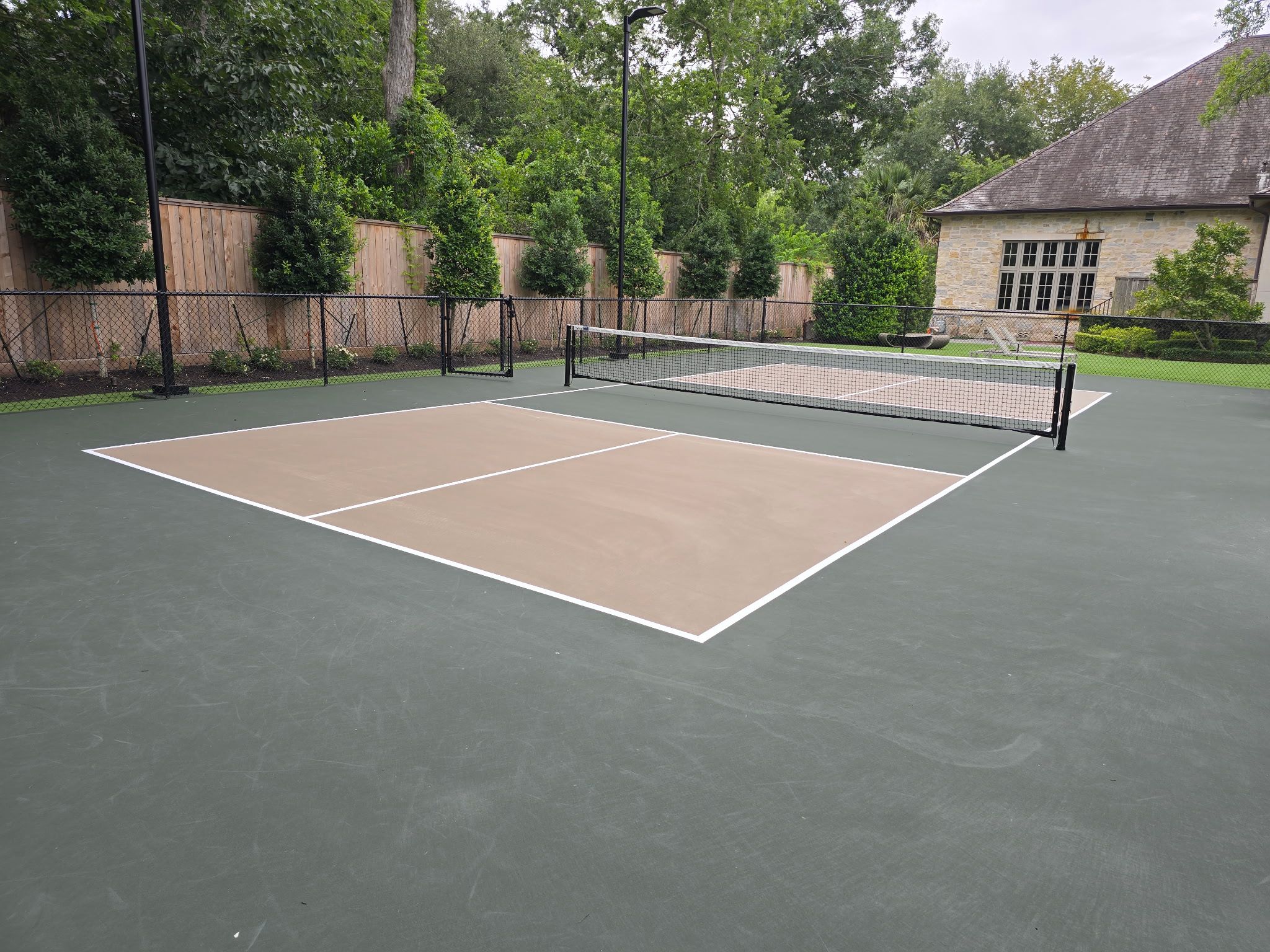
Most permanent outdoor courts use an acrylic surface installed over concrete or asphalt. The coating gives the court its color, texture, and finished game lines.
Homeowners generally compare two versions.
Standard Acrylic
Standard acrylic creates a firm playing surface with consistent ball response. Texture within the coating provides traction, and owners can choose from a broad range of court colors.
This is often the practical choice for families who expect casual or moderate use. It delivers the familiar feel of an outdoor hard court without the added layers and cost of cushioning.
Cushioned Acrylic
Cushioned acrylic includes resilient layers beneath the color coating. It still feels firm during play, but stops and changes of direction feel less harsh underfoot.
Quality & Heritage Court Services offers Cushion X Court Services for homeowners who want more comfort without giving up dependable bounce and traction. It may be especially useful when family members plan to play several times each week.
The cushion does not replace a stable base. Drainage, foundation quality, and preparation still decide how the finished court will perform over time.
Should You Add a Fence Around the Court?
A fence saves a surprising amount of time. Without one, balls find their way into shrubs, pools, driveways, and neighboring yards.
Not every court needs a full enclosure. Some properties only need fencing or netting behind the baselines. Others require protection on all sides because the surrounding yard is small.
Consider:
• Height and location: A short fence may contain low balls but will not stop every high shot. Tall fencing offers better containment, though it can feel imposing if placed too close to the playing lines.
• Gates: A gate should be wide enough for equipment and future maintenance. Its location should not require people to cross an active playing area upon entering.
• Appearance: Dark-coated fencing tends to blend with a residential landscape. Shrubs can soften the view further, provided they do not shed heavily onto the court.
• Local approval: Fence height and placement may be regulated by the city or HOA. Confirm the rules before ordering materials.
Leave enough space between the painted lines and fencing. Saving a few feet during planning can make the court feel cramped every time someone chases a deep ball.
How Can You Make a Backyard Court Easier on the Neighbors?
Court noise is worth discussing before construction, especially when homes are close together.
The most effective choice is usually location. Distance between the court and neighboring patios or bedrooms gives the sound more room to fade. A court placed directly beside a shared fence is more likely to become a source of frustration.
Other practical steps include:
• Choose reasonable playing hours: Early morning and late-night games are more noticeable because the neighborhood is otherwise quiet.
• Plan the orientation carefully: Avoid pointing the open ends of the court directly toward a nearby patio or bedroom when the property offers a more suitable position.
• Consider visual and acoustic screening: Suitable fencing, approved barriers, and landscaping may help, although plants alone will not block all sound.
• Talk with close neighbors: Letting them know what is planned can prevent surprise and make it easier to discuss reasonable expectations.
Good neighbor planning should also cover lighting. A quiet court with fixtures shining into the house next door can create just as much tension.
How Is a Backyard Pickleball Court Built?
Construction involves more than pouring a slab and painting lines.
1. The yard is evaluated: The contractor checks the available space, slope, soil, access, drainage, sunlight, and nearby structures.
2. The layout is marked: Court position, orientation, clearances, fencing, and planned equipment are confirmed before excavation.
3. The ground is prepared: Vegetation and unsuitable soil are removed. The subgrade is shaped and compacted, then the required base material is placed.
4. Drainage is addressed: The playing slope and the path of water around the property are built into the plan.
5. The foundation is installed: Concrete or asphalt is placed in accordance with the design. Concrete needs time to cure before acrylic coating can begin.
6. The surface is completed: The foundation is prepared, acrylic or cushion layers are applied, and the selected colors and game lines are installed.
7. Fencing, lights, and equipment are finished: The net system, gates, fixtures, and other accessories are installed and checked.
Several weeks may pass between the first day of excavation and the first game. Concrete curing, permits, rain, humidity, and material schedules all affect the timeline.
Frequently Asked Questions
It can work when the driveway has enough space, a suitable slope, and pavement in good condition. Parked vehicles, cracks, drainage, traffic, and nearby obstacles may limit its usefulness. Have the surface inspected before investing in permanent coating and lines.
A temporary net can be placed on grass for casual family activity, but the ball will not bounce consistently. A permanent court needs a firm surface, typically concrete or asphalt finished with an appropriate coating.
That depends on local setbacks, easements, fence rules, and HOA restrictions. Lighting poles and tall fences may follow different rules from the playing surface. Confirm the requirements for the specific address before approving the layout.
Yes. A basketball goal and additional lines can be included when the layout provides enough room. The colors should remain easy to distinguish so players are not sorting through several equally bold markings during a game.
Regular care includes removing leaves and dirt, keeping drainage paths open, carefully cleaning stains, and watching for cracks or worn surfaces. Acrylic surfaces also need resurfacing from time to time, based on use and weather exposure.
It will replace a sizable area of lawn and change how water moves across the property. Construction access may also temporarily disturb grass or landscaping. A thoughtful plan can connect the court to the home with suitable walkways, screening, and drainage.
Why Choose Quality & Heritage Court Services?
A backyard court has to fit the property, not simply the official dimensions. Quality & Heritage Court Services begins by looking at how the space actually works.
Homeowners choose our team for:
• Planning built around the yard: We consider the home, property lines, slope, sunlight, nearby activity areas, and player clearances before settling on a layout.
• Experience with Texas conditions: Soil movement, heavy rain, heat, and long periods of direct sun are considered during foundation, drainage, and surface planning.
• Complete project coordination: Foundation work, acrylic or Cushion X surfacing, fencing, lighting, game lines, and equipment can be planned together.
• Clear recommendations: We explain which features serve the project and where simpler choices may be enough.
• Long-term service: Maintenance, repairs, and resurfacing remain available as the court ages.
Contact Quality & Heritage Court Services today to schedule an on-site consultation and receive a plan based on your property.