
Overview
A professionally built outdoor basketball court can cost anywhere from $20,000 to more than $100,000 in 2026 . That is a wide range, but the cost of a basketball court depends on far more than the painted dimensions.
Most residential half-courts land between $20,000 and $50,000 . Full courts typically start around $50,000 and can exceed $100,000 when lighting, fencing, premium goals, or custom surfacing are included . A smaller shooting area may come in below these ranges if the yard is level and the design stays simple .
The only way to narrow the number is to look at the property. Soil, drainage, slope, equipment access, and the chosen surface all affect the estimate .
Quality & Heritage Court Services builds residential and commercial basketball courts across Texas. We plan each project around the site, the available budget, and how the court will really be used.
Have a size or budget in mind? Contact our team to schedule an on-site evaluation and learn what is possible for your property.
Why Do Basketball Court Prices Vary So Much?
From the fence, two finished courts may look almost identical. Their construction could have been completely different.
One court may sit on flat ground close to the driveway. Trucks and equipment can reach it without disturbing the rest of the yard. Another court may be tucked behind a house on sloping land, with a pool, irrigation system, and mature trees in the way.
Those differences show up in the price.
The main cost factors include:
• Court dimensions
• Excavation and grading
• Soil conditions
• Drainage
• Concrete or asphalt construction
• Surface material
• Basketball goal selection
• Fencing or ball netting
• Lighting and electrical work
• Custom colors and graphics
• Permits
• Access for construction equipment
Square footage is useful, but it cannot describe the entire job. The work required before the concrete is poured often has just as much influence on the budget as the concrete itself.
How Big Is a Basketball Court, and What Does Size Do to the Price?
A professional basketball court measures 94 feet by 50 feet. A high school court is 84 feet by 50 feet. Those measurements stop at the playing lines. The actual project needs more room for the goals, fencing, gates, and space beyond the boundaries.
Few backyards can comfortably hold a regulation court. Most homeowners are better served by a half court or a smaller shooting area designed around the yard.
Small shooting area: A 20-foot by 25-foot pad gives you room to practice free throws, work on close shots, and pass the ball around with the kids. It is not designed for full games, and fitting an entire three-point arc into the space can be difficult.
Residential half court: There is no single backyard half-court size. Many fall somewhere between 30 feet by 30 feet and 50 feet by 50 feet. If the yard and budget allow, the extra room makes drives, baseline shots, and one-on-one games feel much less crowded.
High school court: A high school court measures 84 feet by 50 feet. That is a lot of pavement for a typical backyard, but it can make sense for a school, church, HOA, or community facility that expects regular group play.
Professional court: A 94-foot by 50-foot court allows full games in both directions. It also needs two goals and enough land around the painted area to keep players away from fences and other obstacles.
As the court grows, so does nearly every part of the estimate. There is more ground to excavate, more concrete to pour, and more surface to coat. A larger layout may also call for another goal, longer runs of fencing, additional light fixtures, and a more involved drainage plan.
It is worth resisting the urge to build the biggest court that will physically fit. A roomy half court often gets more use than a full layout crowded against landscaping or a property line. The best size is the one that feels comfortable during play and still leaves room in the budget for a sound foundation and a quality finish.
Is Concrete or Asphalt Better for an Outdoor Basketball Court?
Both materials can form the base of an outdoor court. The better choice depends on the site, climate, budget, and expectations for long-term care.
What Should Owners Know About Concrete?
Concrete creates a firm, stable playing base and is widely used for residential basketball courts in Texas. Acrylic coatings, cushioned systems, or modular tiles can be installed above it.
Not all concrete slabs are built the same way. Thickness, reinforcement, preparation, curing, and joint placement influence the result. Post-tension concrete may be recommended where soil movement is a concern.
Concrete often costs more upfront than asphalt, but a properly designed slab can provide a dependable foundation for years of play.
What Should Owners Know About Asphalt?
Asphalt may have a lower initial price and is often used on larger outdoor projects. It has some flexibility, but it still needs a stable base and dependable drainage.
Texas heat can soften asphalt. As it ages, the material may become brittle or develop cracks. Maintenance and future repairs should be considered along with the installation price.
Neither foundation performs well over poorly compacted soil. The condition beneath the pavement matters more than how the surface looks on the first day.
How Does the Playing Surface Change the Price?
Once the foundation is ready, the playing surface gives the court its color, texture, traction, and finished character.
Standard Acrylic
Acrylic coatings are installed in layers over prepared concrete or asphalt. Texture is added to create traction, followed by the selected colors and basketball lines.
Standard acrylic is popular because it offers:
• Dependable ball response
• A familiar hard-court feel
• Good traction
• A wide choice of colors
• Clear game lines
• Straightforward routine care
It is generally the more affordable finished surface. The concrete or asphalt still needs to be properly cured, dry, and prepared before coating begins.
Cushioned Acrylic
A cushioned system adds resilient layers beneath the acrylic finish. The court remains firm enough for predictable dribbling, but it feels less harsh during running, landing, and quick direction changes.
The extra layers increase material and labor costs. They also require additional application and drying time.
Quality & Heritage Court Services offers Cushion X for owners who want the response of acrylic with more comfort underfoot. It can be a sensible upgrade for families who play often, schools, clubs, and other busy facilities.
Modular Tiles
Modular tiles are installed above a prepared concrete or asphalt base. They are available in many colors and patterns and may provide some impact relief.
A tiled surface sounds and feels different from acrylic. Ball response, traction, drainage, cleaning, and future replacement costs all deserve consideration before a selection is made.
If possible, spend time on the type of surface you are considering. A few minutes of dribbling and shooting can reveal more than a product description.
How Much Do Goals, Fencing, and Lighting Add?
The playing surface is only one part of the court. Equipment and surrounding features can take up a meaningful share of the budget.
Basketball Goals
A heavy-duty in-ground goal can cost several thousand dollars, including installation. Backboard size, adjustment mechanism, pole construction, overhang, padding, and rim style all influence the price.
Goal placement should be determined before concrete is poured. The footing, sleeve, or anchor system needs to work with the slab design.
A half court usually needs one goal. A full court requires two, doubling this part of the equipment budget.
Fencing and Ball Netting
Some properties need a full fence. Others only need protection behind the goal to keep basketballs away from windows, pools, vehicles, or neighboring yards.
Fence height, length, finish, gates, and post foundations affect the price. Black or dark-coated fencing often blends into a residential yard more quietly than a bright galvanized finish.
Court Lighting
Lighting lets families and facilities use the court after sunset. The cost depends on the number of fixtures, pole height, electrical service, controls, wiring distance, and desired coverage.
A court far from the main panel may require long trenches and additional electrical work. Residential lighting should also be designed with neighboring homes in mind. More light is not always better if much of it spills outside the playing area.
Which Upgrades Can Raise the Basketball Court Cost?
This is the part of the project where the budget can quietly grow.
Popular additions include:
• Custom surface colors
• Painted logos or family initials
• Pickleball lines
• Rebound walls
• Goal padding
• Benches or viewing areas
• Shade structures
• Scoreboards
• Equipment storage
• Walkways and landscaping
Choose features based on how often they will be used. A family that plays pickleball every weekend may get real value from adding a second line layout. A scoreboard may sound appealing during planning but go untouched after the first month.
Some additions can wait. Others should be planned early. Electrical conduit, goal footings, sleeves, and structural details are easier to include before the slab and surrounding landscape are finished.
Does a Commercial Basketball Court Cost More?
Usually, a commercial court is expected to accommodate more players, longer hours, and greater wear and tear.
Schools, churches, clubs, HOAs, hotels, and recreation facilities may also need:
• Commercial-grade goals
• Two-way court layouts
• Accessible paths and gates
• Higher fencing
• Larger lighting systems
• Seating
• Security controls
• Branded colors or logos
• Additional walkways or parking
Permits, engineered plans, inspections, and coordination with other contractors can add time and cost.
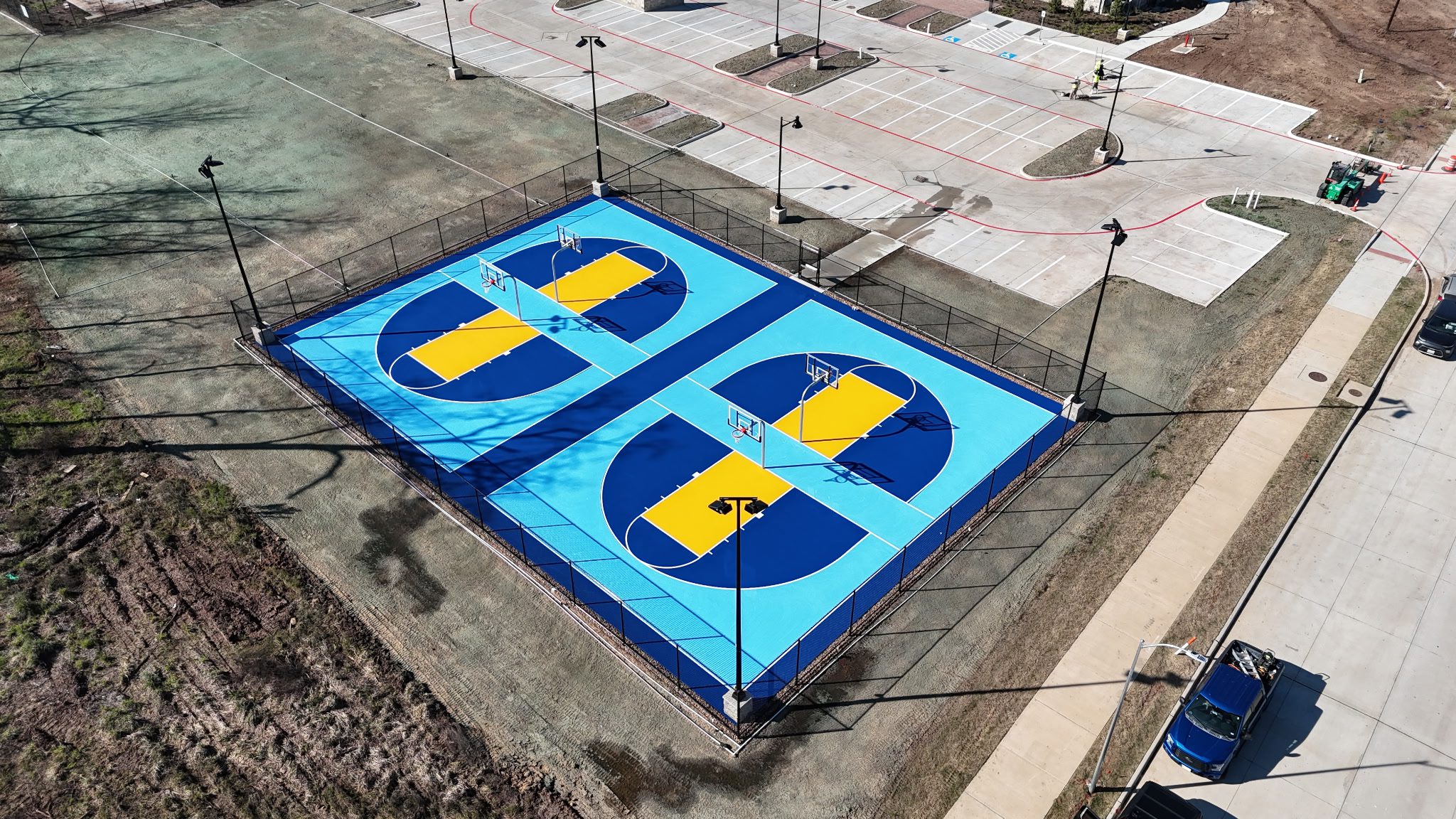
Building several courts together may create some efficiencies. Equipment, labor, drainage, and electrical infrastructure can sometimes be shared across the project. The total investment remains larger, but the cost per playing area may improve.
How Long Does It Take to Build a Basketball Court?
A straightforward residential court may take several weeks once construction starts. Large or complicated projects take longer.
Work generally moves through these stages:
1. Site layout and preparation
2. Excavation and grading
3. Drainage and base installation
4. Concrete or asphalt construction
5. Foundation curing
6. Surface preparation
7. Acrylic coating or tile installation
8. Line painting
9. Goal, fence, and lighting installation
10. Final inspection and cleanup
Concrete cannot be coated immediately after pouring. It needs enough time to cure before the surface work begins.
Rain, high humidity, permitting, material availability, and unexpected soil conditions may extend the schedule. A few weather delays are better than applying coatings to a damp or unready surface.
Frequently Asked Questions
Most professionally built backyard half courts cost between $20,000 and $50,000 in 2026 . A compact design on level, accessible ground may cost less . Grading, premium surfacing, fencing, lighting, and custom features can move the project above that range .
It can be, but the driveway needs to be large, level, and in good condition. Cracks, slope, drainage, parked vehicles, and nearby traffic may interfere with play. The pavement should be inspected before coatings or lines are added.
A small shooting pad can fit into a limited space. A half court with room behind the three-point line needs a much larger area. The layout should include clear space beyond the painted boundaries so players do not run directly into fencing, landscaping, or walls.
Yes. Pickleball lines and a suitable net system can be incorporated into the design. Using clearly different line colors makes both layouts easier to follow.
Many acrylic courts are resurfaced roughly every four to eight years. Frequent play, strong sunlight, drainage problems, and limited maintenance can shorten that period. The condition of the surface is more useful than its age alone.
A well-designed court may appeal to buyers who enjoy recreation and outdoor living. The effect on value depends on the neighborhood, yard size, court condition, and how naturally the installation fits the property.
Why Choose Quality & Heritage Court Services?
A basketball court estimate should explain what is being built and where the money is going. It should account for the property instead of relying on a single square-foot price.
Quality & Heritage Court Services works with homeowners, schools, churches, clubs, HOAs, hotels, and commercial facilities across Texas. Our team reviews the soil, slope, drainage, access, foundation, surface, and planned features before setting the scope.
Clients choose us for:
• On-site planning: Based on the property
• Residential and commercial construction experience: Built for high performance and durability
• Standard acrylic and Cushion X surface options: Tailored for comfort and playability
• Custom colors and multi-use layouts: Designed to fit your exact style and sports needs
• Coordinated goals, fencing, lighting, and accessories: Complete turnkey solutions
• Maintenance and resurfacing support after construction: Long-term protection for your investment
• Practical recommendations for Texas conditions: Engineered specifically for local climate challenges
We are here to help owners make decisions that suit how the court will be used, not to fill the project with upgrades that serve no purpose.
Have a size or budget in mind? Contact Quality & Heritage Court Services today to discuss your available space and receive a detailed construction estimate.