
Overview
If you are planning a regulation tennis court, expect the actual on-site build to take anywhere from four to eight weeks. But looking strictly at the calendar misses the bigger picture. A professional court isn't just a slab of poured concrete with a couple of coats of green paint. It is a highly engineered, multi-layered structural asset built to shed water instantly and survive years of soil shifting.
The physical work moves incredibly fast once the heavy machinery rolls in, but material chemistry and engineering laws dictate the rest of the schedule. You cannot rush local zoning permits, deep earthwork, or the critical curing windows required for concrete and asphalt. Trying to cut corners on these phases directly causes premature cracking, uneven ball bounces, and surface bubbling later on.
At Quality & Heritage Court Services, we focus on structural realities. We plan every build around proven civil engineering practices so your facility handles years of hard match play and brutal weather cycles without failing.
Planning a new facility or residential build? Connect with our engineering team today for a comprehensive site evaluation and precise project timeline.
How Long Do Planning, Site Engineering, and Permitting Take?
Expected Timeline: 2 to 6 Weeks (Dependent on Jurisdiction)
Long before an excavator cuts into your soil, we have to handle the legal and structural groundwork to ensure your court is both legally compliant and physically playable.
Why does solar orientation matter? We map the court along a strict North-South axis. Failing to do so would force players to serve directly into the blinding sun during peak morning or afternoon play windows.
What happens during site engineering? Our team conducts topographic checks to determine how much dirt needs to be cut or filled to achieve a uniform slope.
What slows down the paperwork? Residential projects often require navigating local HOA variances, verifying strict property line setbacks, and pulling environmental permits. For commercial clubs, schools, or public municipal facilities, this phase expands to include rigorous civil reviews, stormwater management approvals, and strict ADA accessibility compliance.
What Is Involved in Earthwork, Subgrade Compaction, and Drainage?
Expected Timeline: 1 to 2 Weeks
Once the local permits are signed off, we bring in the heavy iron. The entire structural lifespan of your court depends on how well the raw dirt beneath the foundation is prepared.
What is clearing and grubbing? We strip away all organic topsoil, root structures, and surface vegetation. Leaving organic material beneath a court pad is a massive structural failure waiting to happen; as the roots rot out over time, they leave hidden voids that cause the asphalt or concrete slab above to sag and break apart.
How do crews ensure the ground is perfectly flat? Our crew uses laser-guided box blades to cut down high points and fill low areas across the footprint. We compact the soil to a strict structural density using heavy vibratory rollers, dialing in a precise 1% slope on a single plane to guarantee rainwater sheets off the court uniformly.
Why is subsurface water a major threat? While the graders are moving dirt, we dig out deep perimeter French drains or cut in stone-lined swales along the low side of the site. Getting groundwater away from the court footprint is non-negotiable. If you let water trap itself under the pad, hydrostatic pressure will eventually push upward, tilting the slab during heavy freezes or forcing moisture through the base until the acrylic finish bubbles right off the top.
How Do Base Construction and Material Curing Affect the Timeline?
Expected Timeline: 1 to 4 Weeks (Strictly Governed by Material Science)
The structural base carries the entire weight of the court. We engineer these foundations using either hot-mix asphalt or post-tensioned reinforced concrete. Neither material can be rushed, as both rely on fixed chemical curing periods.
How long does a hot-mix asphalt base take to cure?
If we use asphalt, we lay down a compacted stone subbase followed by two separate lifts of hot structural asphalt. Once rolled flat, the asphalt must sit entirely undisturbed for a strict 14-day curing window. This allows the volatile oils in the mix to escape completely. If you coat green asphalt too early, those oils will bleed upward and destroy the chemical bond of your acrylic color system, ruining the finish.
What is the curing requirement for post-tensioned concrete?
For the highest level of structural durability, we pour concrete reinforced with internal steel cables that are torqued to immense structural tension. Concrete requires a strict 28-day hydration curing window. The slab must fully cure, and moisture vapor emission levels must fall below strict industry thresholds before our crews can safely apply the finishing layers.
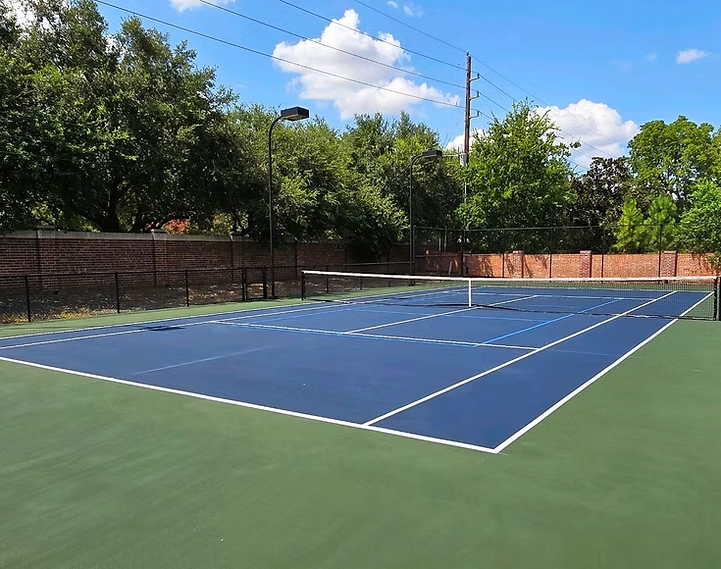
When Are Perimeter Fencing, Net Anchors, and Lighting Installed?
Expected Timeline: 1 Week (Parallel with Base Work)
While the structural base stabilizes and cures, our crew works along the perimeter to install the heavy hardware that makes the court functional.
How do net posts stay stable under high tension? Net posts have to withstand several tons of continuous cable pull without leaning inward over time. To handle that stress, we cast heavy-duty ground sleeves deep into massive, independent concrete footings beneath the slab line.
What else is built during this phase? We drill and set structural fence posts along the outer boundary, string heavy-gauge chain-link fabric, and install gates and windscreens designed to withstand local wind loads. If your project includes night play, we use this window to run all below-grade electrical conduits, pour structural light-pole foundations, and pull the wiring so your utilities are cleanly buried beneath the court footprint.
How Long Does Acrylic Surfacing and Precision Line Painting Take?
Expected Timeline: 3 to 5 Days (Weather Permitting)
This is where the raw concrete or asphalt slab gets its actual playing characteristics. You cannot rush this stage; if the material is pulled incorrectly or applied in poor conditions, the finish will skin over, delaminate, or wear thin within a single season.
What are the baseline layers? We start by squeegeeing structural acrylic resurfacer directly over the bare base. This black or gray filler coat seals the porous surface of asphalt or concrete, smooths out the micro-grain, and ensures a uniform bond for the color coats. For premium projects, this is when we lay down successive coats of liquid-rubber cushioning particles to build a shock-absorbing mat that saves a player's knees and lower back.
What gives the court its grip and color? Next, we mix fine, round-grain silica sand directly into highly pigmented acrylic resins. We pull this mix across the court using heavy rubber floor squeegees. The sand is critical; it gives the ball its standard USTA/ITF friction response and provides the raw foot traction players need to stop and change direction without sliding.
How are the lines applied? Once the color coats have cured, our crew pulls long steel tapes to map the layout precisely to regulatory standards. We snap the chalk lines, apply heavy masking tape with a mechanical line machine, seal the edges to prevent bleeding, and roll on a high-grade, non-glare textured white athletic paint.
Why Does the Weather Dictate the Coating Schedule?
Acrylic coatings are water-borne polymers that rely completely on evaporation to cure. If the local microclimate isn't exactly within specification, the chemistry fails on a structural level.
Surface and Air Temperatures: We will not unbox acrylic materials unless both the slab and the air are at least 50°F and rising. If it's too cold, the polymer film cannot cross-link properly. The paint will dry to a weak, powdery finish that shells off the ground under heavy foot traffic.
The Dew Point and Humidity Trap: High humidity kills evaporation. If the water in the wet mix cannot escape into the air, the lower layers stay gummy while the top layer skins over. This traps moisture pockets directly underneath the paint, leading to widespread surface blistering and bubbling.
Sudden Rain Sweeps: Raw acrylics are completely water-soluble until they fully cure. A single unexpected downpour mid-process will wash thousands of dollars of wet material right into your grass. If the slab gets wet, everything stops until the moisture levels inside the stone or concrete drop back down to absolute zero.
What Happens During the Punch List, Net Calibration, and Hand-off?
Before we pack up the trucks and pull off the site, our project supervisor conducts a comprehensive physical audit of the court to identify any minor structural or cosmetic imperfections.
How do you test for flat surfaces? Our first step is a standard field flood test. We heavily soak the entire acrylic surface and let it sit for exactly one hour. If we spot any low depressions that hold water deeper than the thickness of a standard dime, we map the boundaries of the "birdbath," mix up a specialized acrylic patch binder, and level the floor to a completely flat surface.
How is the equipment calibrated? Once the floor is clear, we mount the tournament net, lower the center strap to exactly 36 inches, and tighten the internal brass winches to ensure the cable maintains tension without binding. If your build includes lighting, we run a full nighttime diagnostic check using a light meter to ensure the footcandles are uniform across the playing lines, with no blind spots for the players.
What Common Roadblocks Can Delay Your Project?
Understanding what can disrupt a timeline allows property owners to budget their time effectively. The most frequent delays stem from:
• Municipal Permitting Overload: Local building departments can take anywhere from a few days to months to process civil zoning permits and stormwater plans.
• Subsurface Soil Surprises: Discovering expansive clay, high water tables, or uncompacted trash layers during excavation may require unexpected soil remediation or additional rock stabilization before the base can be poured.
• Material Lead Times: Custom commercial fencing packages, heavy-duty structural light poles, or specialized cushioned surfacing materials can occasionally run into manufacturing or freight delays.
Can you build a tennis court faster if the ground is already flat?
While a naturally flat site reduces the initial volume of dirt to be moved, it does not eliminate the non-negotiable curing times required for hot asphalt or structural concrete. Skipping curing windows will always result in a catastrophic surface failure.
Is concrete faster to build on than asphalt?
No. While concrete can technically be poured faster than asphalt can be laid in multiple lifts, post-tensioned concrete requires a 28-day curing window before it can be coated, compared to asphalt’s 14-day window.
Why does proper tennis court drainage matter so much for the construction schedule?
If drainage is ignored during the initial earthwork phase, heavy rains will saturate the subgrade soil, turning it into a muddy, unstable mess. This stalls heavy equipment operations and delays base installation for weeks while the ground dries out.