
Overview
At first glance, a padel tennis court can look like someone placed a tennis net inside a glass room.
Then the game begins.
The ball rebounds from the walls, players keep rallies alive from positions that would be impossible in tennis, and the small enclosed space suddenly feels quick, social, and full of movement. It does not take long to see why padel has developed such an enthusiastic following.
Padel is usually played by four people, with two players on each side. It uses solid rackets, a lower-pressure ball, an underhand serve, and a court surrounded by glass and metal fencing. The enclosure is not there simply to keep the ball inside. The walls form part of the game.
That detail changes everything.
A good padel court is not just a reduced tennis court with fencing around it. Its dimensions, glass, structural frame, turf, net, lighting, drainage, and openings all have to work together. If one part is poorly designed, players will notice it in the bounce, movement, visibility, or overall feel of the game.
Quality & Heritage Court Services designs and installs padel courts for private properties, clubs, schools, residential communities, resorts, and commercial facilities. If you are considering a court in Texas, contact Quality & Heritage Court Services today to discuss the site and how the facility will be used.
What Is Padel?
Padel is a racket game that combines familiar elements of tennis and squash while creating a style of play all its own.
It is played across a net, and the scoring system will feel familiar to tennis players. However, the court is smaller, the serve is underhand, and the surrounding walls can be used after the ball bounces.
Players use compact, solid rackets without strings. The rackets usually have perforations across the face and a wrist strap for safety. The ball looks similar to a tennis ball but is designed to meet padel specifications.
The game is easy enough for beginners to start enjoying quickly. Players do not need the same serving power or court coverage demanded by tennis. The enclosed layout keeps more balls in play, and doubles teams can build rallies without every point ending after one or two shots.
That accessibility does not make padel simple. Experienced players use the glass, corners, spin, positioning, and changes of pace with remarkable precision. The better someone becomes, the more strategic the enclosed court feels.
According to the International Padel Federation’s history of the game, padel began in Acapulco, Mexico, in 1969. Enrique Corcuera did not have enough room for a full tennis court, so he created a smaller 20-meter by 10-meter court surrounded by walls. Those walls became an essential part of the sport rather than a compromise.
Is Padel the Same as Tennis?
No. The two games share a net and a similar scoring system, but they are played differently.
A tennis player can often pick up the basic idea of padel quickly, yet tennis habits do not always transfer perfectly. Power matters, but positioning, patience, controlled placement, and understanding the walls are often more important.
The Court Is Smaller
A padel court measures 20 meters long by 10 meters wide, which is approximately 65 feet 7 inches by 32 feet 10 inches.
A regulation tennis court has a 78-foot-long playing area and a doubles width of 36 feet. It also needs substantial open run-off space around the lines.
The padel playing area is shorter and slightly narrower. More importantly, it is enclosed, so the construction footprint works differently.
The Court Has Walls
A tennis rally normally ends when the ball moves beyond the playable boundaries. In padel, the ball can rebound from the glass after it has bounced on the playing surface.
Players learn to let certain shots pass them, read the rebound, and return the ball after it comes away from the back wall. The glass adds time, angles, and defensive opportunities.
The Serve Is Underhand
Padel uses an underhand serve after a bounce. The contact is made at or below waist height under the applicable rules.
This makes the serve easier for beginners to place in play and shifts the game away from the powerful overhead serving style associated with tennis.
Padel Is Usually Played in Doubles
Singles padel courts and variations exist, but the standard game is designed for two players on each side. The court proportions, tactics, and use of the walls all support doubles play.
The Rackets Are Solid
Padel rackets do not have strings. They have a solid hitting face, usually with holes, and are smaller than tennis rackets.
The shorter handle and compact shape make the racket easier to control in close exchanges near the net and walls.
Is Padel the Same as Paddle Tennis?
No. The similar names create understandable confusion.
Padel, paddle tennis, and platform tennis are separate games with different courts, equipment, and rules. A padel court is recognized by its 20-meter by 10-meter enclosed playing area, glass walls, metal fencing, and central net.
When researching a contractor or requesting a proposal, use clear terms such as “padel court” or “padel tennis court.” A reference only to a paddle court may lead to the wrong design, measurements, or equipment.
What Are the Official Padel Court Dimensions?
The standard internal playing area is 20 meters long by 10 meters wide. The net divides the court into two equal sections measuring 10 meters by 10 meters.
The current International Padel Federation Rules of Padel state that the court must be completely enclosed. The internal ends are 10 meters long, while the internal sides are 20 meters long.
In feet, the playing area is approximately:
• 65 feet 7 inches long
• 32 feet 10 inches wide
These are inside measurements. They do not represent the complete space required for construction.
The project also needs room for:
• The structural frame
• Glass and fence supports
• Entry openings
• Lighting poles or integrated lighting
• Drainage
• Foundation edges
• Walkways around the court
• Construction and maintenance access
• Seating or viewing areas
• Out-of-court play where planned
A property should never be evaluated using only the internal court size. The total facility footprint will be larger.
Why Is a Padel Court Enclosed?
The enclosure defines the game.
Without the walls, padel would lose many of the rebounds, defensive recoveries, and tactical exchanges that make it distinct. The glass and fencing also keep the playing area compact and help contain the ball.
The enclosure has to provide predictable play. The ball should respond consistently when it strikes an approved playing wall. Uneven joints, poorly aligned panels, or incompatible materials can produce awkward rebounds.
Glass Walls
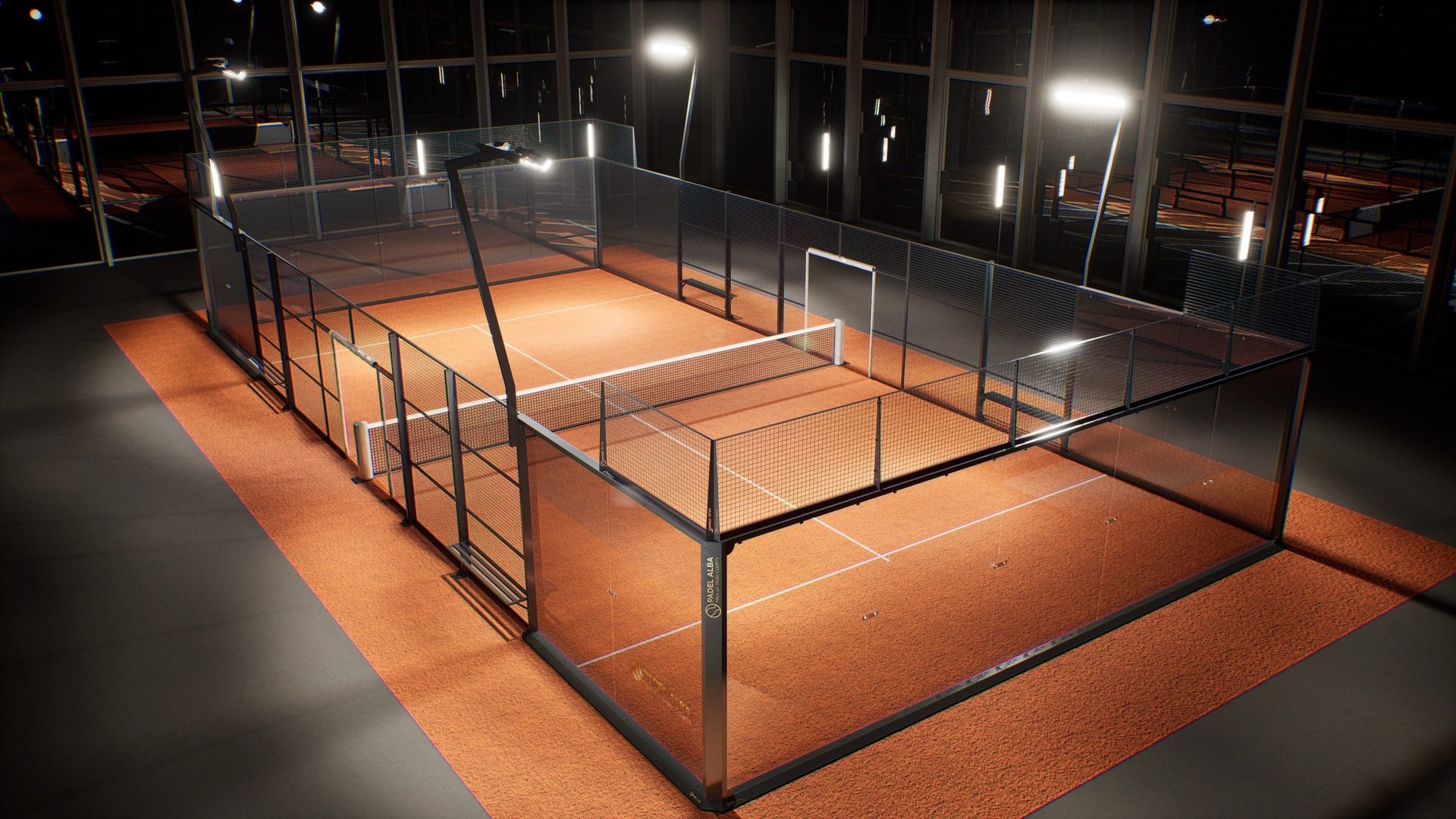
Modern padel courts commonly use tempered glass at the ends and selected side areas. The transparent enclosure gives spectators a clear view and creates the open appearance associated with clubs and professional venues.
The glass must be appropriate for the system, properly supported, and installed with careful attention to alignment, hardware, and tolerances.
It should not be treated like ordinary decorative glazing. Players use the walls during active play, and the panels may experience repeated ball contact, vibration, wind, and environmental exposure.
Metal Fencing
Metal mesh completes the enclosure where glass is not used. The fence behaves differently from the glass when struck by the ball, and players learn to read those changes.
The mesh, openings, joins, posts, fasteners, and transitions should follow the selected court system and intended standard of play.
Sharp projections, inconsistent gaps, loose mesh, or abrupt changes between materials can affect both safety and performance.
Structural Frame
The frame supports the glass, fencing, doors, and in some systems, lighting. It also has to withstand environmental loads.
Texas wind should not be an afterthought. The court system and its foundations need to be appropriate for the site, exposure, local requirements, and engineering conditions.
A court installed beside an open field may experience wind differently from one sheltered by buildings. Local structural requirements should be checked for the specific property.
How High Are the Walls on a Padel Court?
The enclosure uses a combination of walls and metal fencing at different heights.
Under FIP rules, the ends have a total height of 4 meters. The lower 3 meters consist of wall material, commonly glass, with an additional meter of metal fencing above.
The side enclosure can use permitted configurations that combine wall sections and fencing. Those arrangements should follow the selected regulation design rather than being improvised on site.
The height is one reason padel court construction requires more than a flat surface contractor. The enclosure is a structural system that must be accurately positioned and securely anchored.
For indoor courts, the building also needs sufficient clear height above the complete enclosure. Roof beams, lights, ducts, fans, and other obstructions should not interfere with lobs or active play.
What Is the Surface of a Padel Court Made From?
Many padel courts use synthetic turf installed over a prepared base.
The turf is not selected only for appearance. Fiber type, pile height, density, infill, seams, drainage, and installation influence movement and ball response.
A player needs enough traction to start, stop, and change direction without feeling locked to the surface. Too little grip can feel insecure. Too much can make turning uncomfortable and increase stress during sudden movement.
Synthetic Turf
Synthetic turf is commonly used because it can provide a consistent playing surface with controlled traction. Sand infill may help stabilize the turf, influence movement, and support the intended performance.
The infill needs to be distributed and maintained properly. Areas with too little or too much material may play differently.
Other Surface Possibilities
Regulations can allow different surface materials when they meet applicable performance requirements. However, clubs and players often expect the familiar feel and appearance of turf.
The surface should be selected as part of the complete court system. A material that works elsewhere is not automatically suitable for padel.
The Base Beneath the Turf
The finished turf can only perform as well as the foundation below it.
The base must be stable, level within the required tolerances, and designed to drain. Poor preparation can lead to low spots, uneven ball response, visible seams, or movement in the structural frame.
Texas properties can have expansive soil that changes as moisture conditions shift. Soil preparation, foundation design, and drainage need to be planned around the actual site.
How Does Drainage Work on an Outdoor Padel Court?
An outdoor padel court needs to move water away without creating puddles or affecting the playing surface.
The enclosure makes drainage planning especially important. Water cannot simply be expected to leave in any direction once glass, frames, curbs, and surrounding construction are installed.
A complete drainage plan may consider:
• The slope of the playing base
• Permeability of the selected surface
• Openings or drainage paths near the enclosure
• Water approaching from surrounding land
• Roof runoff from nearby buildings
• Collection systems or channels
• The final discharge location
• Erosion around the court foundation
Texas weather can shift from prolonged dry conditions to intense rainfall. A drainage design should be prepared for real storms, not only routine irrigation or light rain.
Standing water makes the court unavailable and can contribute to organic growth, displaced infill, staining, corrosion, and premature surface problems.
The land around the court should be graded as carefully as the area inside it.
Does a Padel Court Need Lighting?
Most club and commercial courts include lighting because players often book matches before work, after work, and into the evening.
Residential owners may also want lights, especially during warmer months when daytime temperatures make evening play more comfortable.
Lighting should be even across the playing area. Players look upward frequently, particularly during lobs and overhead shots, so glare can quickly make a court unpleasant.
The design should consider:
• Fixture height
• Pole or frame placement
• Light distribution
• Glare
• Shadows near the glass
• Reflections
• Spill onto neighboring properties
• Energy use
• Controls and operating hours
• Local permits and HOA restrictions
Fixtures may be mounted on dedicated poles or integrated with the court structure, depending on the selected system.
Lighting should be part of the first design, not an upgrade added after the foundations and enclosure are complete. Pole bases, wiring, controls, and power supply need to be coordinated before construction.
Can Padel Courts Be Built Indoors?
Yes. Indoor padel courts offer year-round play and remove many weather interruptions.
The building needs enough clear height for lobs. The lowest roof beam, light, duct, fan, or other obstruction matters more than the height at the roof peak.
Indoor facilities also need thoughtful lighting, ventilation, temperature control, acoustics, emergency access, and circulation around the courts.
A building with several courts should provide enough room for players to enter and leave without interrupting nearby matches. Reception, waiting areas, restrooms, storage, seating, and maintenance access also need space.
Converting an existing warehouse can be possible, but column spacing and roof height must be checked carefully. A building can look enormous and still have columns in exactly the wrong places.
An indoor padel facility is not simply a matter of fitting several 20-meter by 10-meter rectangles onto a floor plan.
Can a Padel Court Be Built Outdoors in Texas?
Yes, provided the court is designed for the property and local conditions.
Outdoor padel court construction in Texas should account for:
• Heat and strong sunlight
• Heavy rain
• Wind exposure
• Expansive soil
• Drainage
• Corrosion resistance
• Surface temperature
• Glass reflections
• Shade patterns
• Lighting restrictions
The orientation of the court also deserves attention. Low sun can affect visibility through the glass and make one side uncomfortable at certain times of day.
Glass, metal, coatings, fasteners, turf, and lighting equipment should be suitable for outdoor use. The court may also need cleaning more frequently because of dust, pollen, leaves, and weather exposure.
A well-designed outdoor court can perform beautifully, but every major component should be selected for the environment in which it will actually sit.
How Is a Padel Court Built?
Padel court construction begins below the surface.
Ordering an enclosure before confirming the site, foundation, drainage, and access can create expensive difficulties later. The work should follow a coordinated plan.
1. Evaluate the Property
The site is measured and reviewed for access, slope, soil, utilities, property lines, easements, drainage, and surrounding improvements. Residential and commercial properties have different needs. A private court may need to work around a pool or home. A club may need parking, walkways, restrooms, spectator space, and several courts positioned together.
2. Confirm the Layout
The internal court dimensions are established, but the layout must also include the enclosure, entrances, structural supports, lighting, drainage, and circulation around the facility. Orientation is considered alongside sun, wind, views, nearby buildings, and property restrictions.
3. Complete Design and Engineering
Plans may be required for the foundation, enclosure, drainage, electrical system, lighting, retaining walls, and other site improvements. Structural details should match the court system and local conditions. The foundations for the frame and lights need to be coordinated with the slab or base.
4. Prepare the Site
The construction area is cleared, excavated, graded, and compacted. Unsuitable material may need to be removed or improved. Good preparation creates a stable platform for both the playing surface and enclosure.
5. Construct the Foundation and Drainage
The base is installed to the required dimensions, levels, and slope. Drainage systems are completed before the surface and enclosure block access. The finished base needs to support consistent play without trapping water.
6. Install the Structural Frame
The steel frame is assembled and accurately positioned. Anchors, posts, connections, and openings must match the court plan. Small alignment errors can become more serious when the glass and fencing are installed.
7. Install Glass and Fencing
Glass panels and metal mesh are fitted to complete the enclosure. Joints, transitions, fasteners, and panel alignment are checked carefully. The finished walls should feel continuous during play.
8. Install the Playing Surface
Synthetic turf and infill are installed according to the chosen system. Seams, lines, pile direction, and infill distribution require close attention. The surface is then groomed and reviewed for consistency.
9. Add the Net, Lighting, and Details
The net, posts, lights, gates, protection, accessories, and any branding are completed. Electrical work is tested, and the court is inspected before being released for play.
Do You Need a Permit to Build a Padel Court?
Possibly, and often yes when substantial construction is involved.
The permit process depends on the property, jurisdiction, and project scope. A court may involve site development, concrete work, drainage, a tall structural enclosure, lighting, electrical service, retaining walls, tree removal, or a new indoor building.
Commercial padel court construction can introduce additional requirements involving:
• Zoning and permitted land use
• Parking
• Accessible routes
• Fire access
• Restrooms
• Occupancy
• Landscaping
• Stormwater management
• Utilities
• Building code
• Signage
• Operating hours
A residential court may also need HOA or architectural approval. City approval does not replace private deed restrictions.
Permit requirements should be checked before the final court location is approved or equipment is ordered. A glass enclosure manufactured for one layout is not easily adjusted after a setback, easement, or drainage conflict is discovered.
Quality & Heritage Court Services works throughout Austin, Dallas, Houston, San Antonio, and surrounding Texas areas.
Who Builds Padel Courts?
Padel court builders need to understand more than the enclosure.
The project connects civil work, foundation construction, structural assembly, glass installation, fencing, turf, lighting, drainage, and game-specific measurements. Those components should not be planned separately and expected to fit together at the end.
Before selecting a contractor, ask:
• Does the proposal include site preparation?
• Who is responsible for drainage?
• What foundation system is included?
• Which padel court system will be installed?
• Are engineering documents included?
• What glass and fencing specifications are proposed?
• Does the price include lighting and electrical work?
• Which turf and infill will be used?
• Who handles permits?
• Are freight, equipment, and installation included?
• What maintenance will the court need?
• Who responds if a problem develops after construction?
A low initial number can become much less attractive when essential site work, drainage, electrical service, or freight has been left out.
Padel court construction services from Quality & Heritage Court Services can bring the court layout, site work, enclosure, surface, and related construction into one coordinated project.
How Much Does Padel Court Construction Cost?
Padel court construction cost varies considerably.
A court installed on a prepared indoor slab is a different project from an outdoor court that requires excavation, soil improvement, foundation work, drainage, utilities, and site access.
The total cost may be affected by:
• Number of courts
• Residential or commercial use
• Indoor or outdoor location
• Site clearing and excavation
• Soil conditions
• Foundation design
• Drainage
• Court system and structural frame
• Glass specification
• Turf and infill
• Lighting
• Electrical service
• Freight and equipment access
• Permits and engineering
• Retaining walls
• Walkways and landscaping
• Seating and spectator areas
• Custom colors and branding
Commercial projects may also need parking, restrooms, reception space, fire access, accessibility improvements, and additional utilities.
A meaningful estimate should identify what is included from the ground up. Comparing only the price of the court kit can create a false picture of the complete investment.
Request a quote for an evaluation based on the property and intended facility.
How Is a Padel Court Maintained?
Padel court maintenance is not complicated when it is handled regularly.
The turf should be kept clean and the infill distributed evenly. Leaves, dirt, hair, fibers, and other debris can collect in the surface and near the enclosure.
Maintenance may include:
• Removing debris
• Grooming the turf
• Redistributing or replenishing infill
• Inspecting seams and game lines
• Cleaning glass
• Checking fence tension and connections
• Inspecting gates and hardware
• Reviewing anchors and structural components
• Cleaning drainage paths
• Checking lights and electrical equipment
• Looking for corrosion or coating damage
The frequency depends on use, environment, and court type. A busy commercial court needs more attention than a private court used on weekends.
Outdoor Texas courts may collect pollen, dust, leaves, and storm debris. Heat and rain also place ongoing stress on the surface and metal components.
Small issues are easier to address before they affect the playing area or enclosure. Court maintenance services can help owners protect the court over time.
Who Is a Padel Court Best For?
Padel works well for a surprisingly wide range of players.
Beginners can begin rallying without first mastering a powerful serve. Tennis players often enjoy learning how to use the walls. Families appreciate the social doubles format, while clubs can schedule matches, lessons, leagues, and events.
A padel court can be a strong addition for:
• Private homes and estates
• Country clubs
• Tennis and racket clubs
• Hotels and resorts
• HOAs and residential communities
• Schools and universities
• Fitness facilities
• Municipal recreation centers
• Dedicated padel clubs
• Mixed-use developments
The smaller footprint compared with a complete tennis facility can make padel attractive where land is valuable. However, the enclosure, circulation, drainage, viewing, and support areas still need careful planning.
For commercial owners, demand should be evaluated alongside court count, booking model, location, parking, staffing, and long-term operations.
Frequently Asked Questions About Padel Courts
A standard padel court has an internal playing area measuring 20 meters long by 10 meters wide. That is approximately 65 feet 7 inches by 32 feet 10 inches. The complete construction footprint must also include the frame, entrances, lighting, drainage, access, and surrounding space.
The walls form part of the game. After the ball bounces on the court, it can rebound from the glass and remain in play. Transparent glass also allows spectators to see the match clearly. The panels must be part of a properly designed structural court system.
Padel is normally played as doubles on the standard 20-meter by 10-meter court. Singles courts and singles play exist, but the regulation-style game and most facilities are designed around two players on each side.
Yes. The internal padel playing area is shorter and slightly narrower than a regulation doubles tennis court. A tennis facility also needs open run-off space, while a padel court uses an enclosure. The complete site area for either project extends beyond the painted dimensions.
Possibly. The existing foundation, dimensions, drainage, slope, condition, and layout must be evaluated. A tennis court may have enough space for one or more padel courts, but the enclosure foundations, access, lighting, and drainage still require proper design.
There is no single lifespan for every court. Longevity depends on the foundation, drainage, court system, glass, steel, turf, climate, level of use, and maintenance. Turf and selected components may require replacement before the main structure reaches the end of its useful life.
Why Choose Quality & Heritage Court Services?
A padel court arrives as a finished system, but its performance depends on every layer beneath and around it. Quality & Heritage Court Services plans padel projects around the property, players, and intended level of use.
Complete Site Planning
The team evaluates the available space, access, grades, drainage, surrounding improvements, and facility goals before construction begins.
Residential and Commercial Padel Courts
A private court has different needs from a multi-court club, resort, school, or community facility. The layout and supporting construction are planned accordingly.
Texas Construction Experience
Outdoor courts must contend with heat, rainfall, wind, and changing soil conditions. Foundation, drainage, structural, and material decisions are made with the site in mind.
Coordinated Court Construction
Quality & Heritage Court Services can coordinate site preparation, foundation work, enclosure installation, turf, lighting, electrical needs, and related improvements.
Interested in bringing padel to your home, club, or commercial property? Contact our team to discuss the site and court options.