
Overview
A beach volleyball court may look like an easy project. Bring in sand, set up a net, paint a few lines, and start playing.
The reality is more involved.
The sand needs to be deep, clean, rounded, and comfortable for players to move through. The ground beneath it must drain properly. The court needs enough space outside the lines for players to chase the ball. Posts, net height, lighting, fencing, walkways, seating, and access all need to be considered before construction begins.
If the base holds water or the sand is too shallow, the court can become hard, uneven, muddy, or difficult to maintain.
Quality & Heritage Court Services helps property owners plan and build volleyball courts for homes, schools, resorts, communities, municipalities, and commercial facilities across Texas.
Planning a beach volleyball court? Contact our team to discuss the property, intended use, and construction requirements.What Are the Official Beach Volleyball Court Dimensions?
A standard beach volleyball playing court measures 16 meters long by 8 meters wide. That is approximately 52 feet 6 inches by 26 feet 3 inches.
The court is divided into two equal 8 by 8 meter sides by the net.
Those measurements describe the playing area inside the boundary lines. Players also need a clear free zone around the court for movement and safety.
The FIVB Official Beach Volleyball Rules provide the court dimensions, line requirements, net details, and playing area guidance for official competition.
How Much Space Is Needed Beyond the Lines?
For many recreational projects, a clear area of at least 3 meters around the court is a useful starting point. Competition facilities may require more space.
The total sand area will therefore be larger than the 16 by 8 meter playing rectangle. The project may also need room for:
• Net posts and anchors
• Lighting
• Walkways
• Seating
• Fencing
• Drainage
• Equipment storage
• Accessible routes
• Maintenance access
A property should be measured using the complete sand and facility footprint, not only the painted court.
What Type of Sand Should a Beach Volleyball Court Use?
Sand is the playing surface, so its quality directly affects comfort, movement, and maintenance.
Beach volleyball sand should be naturally weathered and rounded rather than made from crushed rock. Sharp or rough particles can make diving uncomfortable and may create cuts or abrasions.
USA Volleyball’s guide to building a beach court notes that the sand should be free of rocks, shells, and dangerous particles. It also discusses sand depth and the volume of material required for a complete court area.
Why Rounded Sand Matters
Rounded grains move more comfortably under a player’s feet. Crushed material can feel harsh and may lock together differently when wet.
Why Clean Sand Matters
Sand can contain stones, glass, roots, metal, shells, or construction debris if it is not screened and prepared properly.
The surface should be checked before installation and again whenever new material is brought in.
How Much Sand Is Needed?
Depth depends on the court type, base, drainage design, and applicable standard. USA Volleyball’s construction guidance discusses a sand area of 28 by 20 meters with a depth of 24 inches for a non beach court example.
That is a large amount of material. Sand volume, delivery access, equipment, grading, screening, and placement should all be included in the budget.
How Deep Should the Sand Be?
Sand depth needs to be consistent across the playing area.
If it is too shallow, players may reach the hard base when they move, dive, or land. If it is too deep, movement becomes tiring and the court becomes harder to level.
Depth can vary depending on the surface system and intended use. Official competition, recreational play, youth programs, and private backyard courts may have different requirements.
The finished sand should be deep enough to support the way players will use the court while still allowing water to move through the system.
The base beneath the sand also matters. A soft or uneven foundation can create low areas that reappear after the sand is placed.
What Should Be Beneath the Sand?
Sand should not simply be poured onto ordinary soil.
The layers below it need to support drainage, stability, and maintenance. Depending on the site, construction may involve excavation, geotextile fabric, aggregate, drainage piping, edging, and a carefully graded base.
Site Excavation
The construction area may need to be cleared and excavated to create room for the base, drainage, and required sand depth.
Graded Aggregate Base
A stable aggregate layer can provide support while allowing water to move toward the drainage system.
Drainage Layer
The design may include perforated pipe, collection drains, channels, or another method suited to the property.
Separation Fabric
A suitable fabric can help separate soil from the drainage and sand layers. The material and installation method should match the site conditions.
Perimeter Edge
An edge keeps the sand from spreading into surrounding landscaping and walkways. It should be secure without creating a hard obstacle beside the free zone.
The exact assembly depends on soil, slope, rainfall, drainage requirements, and the type of court being built.
How Important Is Drainage for a Beach Volleyball Court?
Drainage is one of the most important decisions in the project.
Sand can allow water to pass through, but it cannot solve a low site, a saturated base, or runoff flowing in from higher ground. If water remains trapped beneath the court, the sand may become uneven, muddy, or slow to dry.
The drainage plan should consider:
• Water entering from surrounding land
• The slope of the site
• Soil permeability
• The depth and type of base
• Collection pipes or channels
• The final discharge location
• Erosion near the perimeter
• Roof, parking, and landscape runoff
Texas weather can move from long dry periods to intense rain. The court should be designed for heavy storms rather than only routine irrigation.
Drainage around the court matters too. Water should not wash sand onto a walkway, toward a building, or onto a neighboring property.
Can a Beach Volleyball Court Be Built on a Sloped Property?
A sloped property may still work, but the court cannot simply follow the natural grade.
The playing area needs to be as level and consistent as the intended use requires. Creating that level area may involve cutting into the higher side, adding fill to the lower side, or using retaining structures.
What Additional Work Might Be Needed?
A sloped site may require:
• Excavation
• Imported fill
• Compaction
• Retaining walls
• Drainage behind walls
• Erosion control
• Steps or ramps
• Additional access for equipment
The work area may need to extend beyond the finished court because walls, slopes, and drainage features require their own space.
A site evaluation should happen before the owner chooses the court location. Moving sand onto an unsuitable slope will not make the underlying grade stable.
How Should the Net System Be Selected?
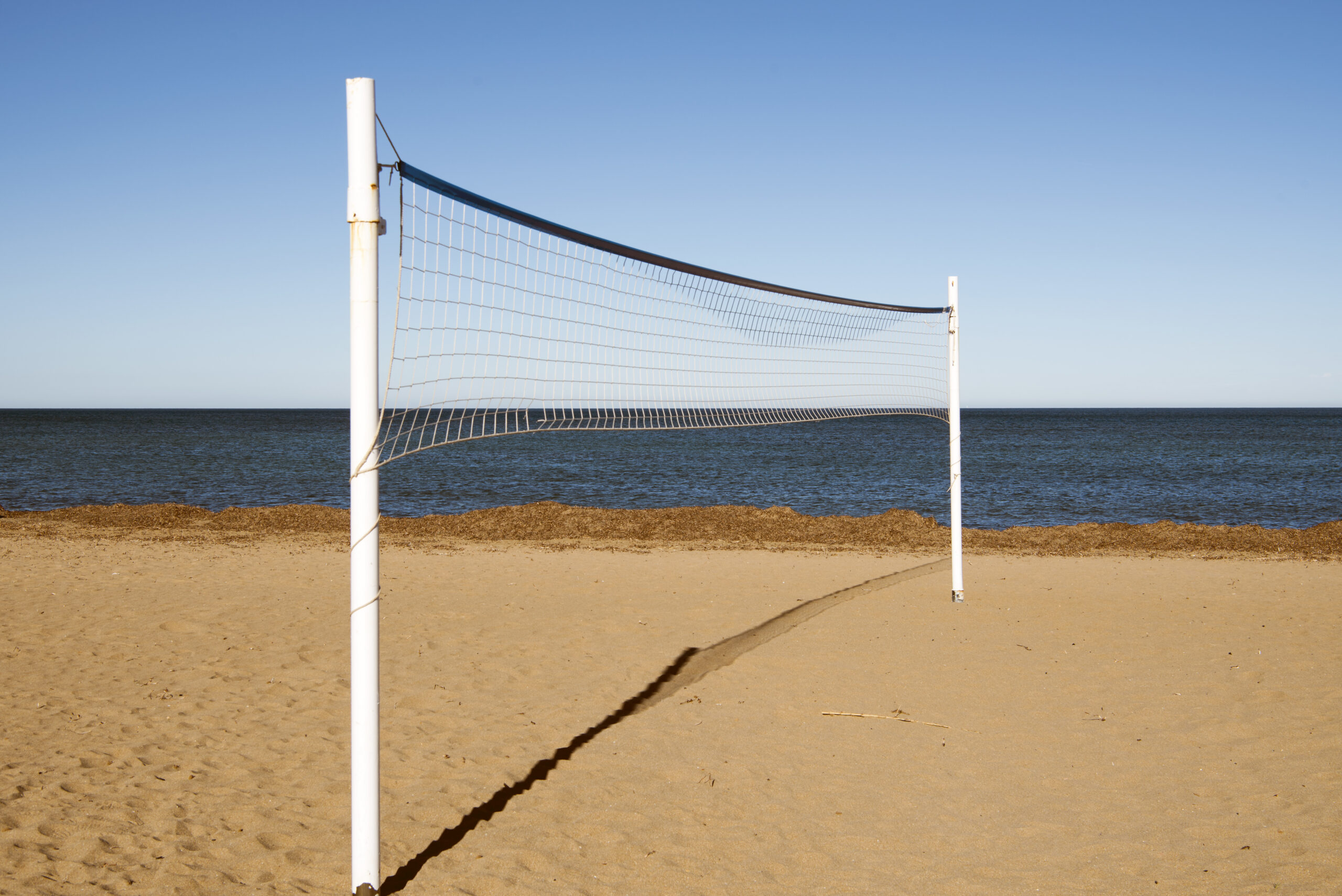
The net system should match the level of play and the way the court will be used.
A permanent facility may need heavy duty posts, secure anchors, protective padding, adjustable tension, and equipment that can tolerate frequent use. A private court may use a simpler system, but the posts still need to remain stable and correctly positioned.
For official beach volleyball, the net height is generally:
• Men’s competition: 2.43 meters
• Women’s competition: 2.24 meters
Youth, senior, and recreational programs may use different heights.
The net should be centered across the 8 meter court width. Posts need to be placed outside the playing area and supported by suitable foundations or anchors.
The 2025 to 2028 FIVB rules provide official net and equipment information.
What Lines Does a Beach Volleyball Court Need?
The boundary lines mark a 16 by 8 meter playing area.
Beach volleyball lines are commonly made from flexible, durable material that remains visible against the sand without creating a dangerous raised edge.
The lines should be:
• Correctly measured
• Firmly secured
• Clearly visible
• Suitable for outdoor exposure
• Safe for players who dive or slide
• Easy to inspect and adjust
The line anchors should not create sharp projections or loose sections. Wind, rain, foot traffic, and repeated maintenance can shift poorly installed lines.
If the court will be used for different formats, line layouts should be discussed before the sand is installed.
Should the Court Have Fencing?
Not every beach volleyball court needs fencing.
A private court may remain open around the free zone. A resort, school, community, or commercial facility may want fencing to contain balls, define the activity area, protect landscaping, or control access.
Fencing should not reduce the space players need around the lines. Gates should open safely and provide practical access for players, guests, equipment, and maintenance crews.
A fence can also affect wind. On an exposed property, the design should be reviewed for local conditions and the way air moves across the court.
The fence should be treated as part of the site plan, not placed wherever the remaining space allows.
Does a Beach Volleyball Court Need Lighting?
Lighting can make the court useful during cooler evening hours, particularly in Texas.
Players look across and upward during serves, sets, blocks, and high defensive plays. Uneven lighting or glare can make the ball difficult to track.
A lighting plan should consider:
• Even coverage across the sand
• Pole location
• Fixture height
• Glare
• Shadows
• Light spill
• Electrical service
• Controls and operating hours
• Local restrictions
Poles should remain outside the playing area and clear zone. Their foundations and wiring need to be coordinated with drainage, fencing, walkways, and seating.
For a resort or commercial facility, separate controls can allow staff to light only the courts being used.
What Facilities Should Surround the Court?
The court is easier to use when the surrounding space has been planned with the same care.
A private backyard court may need only a path, storage area, and a place to sit. A resort or community facility may need shade, seating, showers, restrooms, drinking water, parking, and guest circulation.
Consider where people will:
• Enter the court
• Store bags and equipment
• Sit between games
• Find water
• Use restrooms
• Watch play
• Reach first aid
• Walk after dark
• Access the court with mobility equipment
Loose chairs, coolers, ball carts, and maintenance supplies should not be left in the free zone.
Accessible routes should remain usable when the court is busy.
The 2010 ADA Standards for Accessible Design can help guide accessible routes and recreation facility planning.
How Is a Beach Volleyball Court Built?
The work should follow a coordinated sequence.
Site Review and Layout
The property is measured for space, slope, soil, utilities, drainage, access, trees, buildings, and restrictions.
Excavation and Base Preparation
The site is cleared and excavated. The base is graded and compacted to create the required levels.
Drainage Installation
Drainage pipes, collection systems, outlets, and erosion protection are installed before the sand blocks access.
Sand Placement
Clean, suitable sand is delivered, screened when needed, distributed, and placed to the planned depth.
Net and Line Installation
Posts, anchors, the net, boundary lines, padding, and related equipment are installed and checked.
Lighting and Surrounding Work
Lighting, fencing, walkways, seating, shade, storage, and landscaping are completed around the court.
Final Review
The surface is checked for depth, level, cleanliness, drainage, line position, net height, and safe access.
A new court should remain closed until the sand has settled and the installation has been inspected.
How Much Does It Cost to Build a Beach Volleyball Court?
The price depends on far more than the cost of sand.
The estimate may include:
• Site clearing and excavation
• Soil removal or improvement
• Aggregate base
• Drainage
• Geotextile fabric
• Sand volume and delivery
• Perimeter edging
• Net posts and anchors
• Lines
• Lighting
• Fencing
• Walkways
• Seating and shade
• Landscaping
• Equipment access
• Permits and engineering
A flat, accessible backyard will require a different scope from a sloped commercial property with retaining walls, stormwater work, lighting, and guest amenities.
The amount and quality of sand can also affect the budget. Delivery access matters because a large sand order may require specialized trucks or equipment.
A written proposal should identify the sand type, depth, base, drainage, equipment, surrounding work, and exclusions.
How Long Does Construction Take?
A simple private court may move faster than a commercial facility with extensive site work.
The schedule can include design, approvals, excavation, drainage, base preparation, sand delivery, installation, lighting, fencing, and final inspection.
Rain can interrupt excavation and sand placement. Saturated ground may need time to dry before equipment can return. Material delivery and site access can also affect the work.
Ask the builder when the schedule begins and whether it includes permits, material ordering, weather delays, and surrounding improvements.
How Should a Beach Volleyball Court Be Maintained?
Sand changes as people play on it.
Players create low areas, footprints, and compacted sections. Wind and rain can move material toward the edges. Leaves, branches, and other debris collect on the surface.
Routine maintenance may include:
• Removing debris
• Raking or leveling the sand
• Checking depth
• Restoring low areas
• Inspecting boundary lines
• Checking net tension and posts
• Clearing drainage paths
• Managing vegetation
• Adding or redistributing sand
The court should be checked after heavy rain and strong wind. A recurring low area may point to drainage or base trouble rather than a simple need for more sand.
Quality & Heritage Court Services provides court maintenance services for properties that need inspections, cleaning, repairs, resurfacing, and ongoing care.
What Should Texas Property Owners Consider?
Texas heat can make the sand extremely warm during the day. Strong sunlight, wind, sudden rain, expansive soil, irrigation, and tree growth can all affect the court and its surroundings.
Shade can improve comfort, but trees also create leaves, roots, and organic debris. A covered seating area may be useful, but its roof runoff needs to be directed away from the sand.
The property should also have a practical maintenance plan. Sand, water, equipment, and replacement materials need to reach the court without crossing delicate landscaping or narrow walkways.
Quality & Heritage Court Services works with property owners in Houston, Austin, Dallas, San Antonio, and surrounding Texas communities.
What Are the Most Common Questions About Beach Volleyball Courts?
The official playing court measures 16 meters long by 8 meters wide, or approximately 52 feet 6 inches by 26 feet 3 inches. Additional clear space is needed around the boundary lines for player movement and safety.
The amount depends on the total sand area, planned depth, base, and court standard. USA Volleyball provides guidance for a 28 by 20 meter sand area with a 24 inch depth example. A builder should calculate the volume for the actual property.
Not every sand is suitable. Beach volleyball sand should be clean, rounded, and free of rocks, shells, glass, roots, and sharp particles. Crushed rock products may feel uncomfortable and may not drain or move as intended.
Not necessarily. Many courts use excavated soil, aggregate, drainage layers, fabric, edging, and sand instead of a concrete playing base. The correct construction depends on the site, drainage, soil, intended use, and local requirements.
The schedule depends on how often the court is used, weather, wind, rain, and the condition of the sand. Busy facilities may need leveling daily or several times a week. Private courts should be checked after play and severe weather.
Yes, if the property has enough usable space, suitable access, drainage, and room for the sand area and surrounding features. Slopes, setbacks, trees, utilities, and nearby structures should be reviewed before selecting the location.
Why Should You Choose Quality & Heritage Court Services?
Site Planning Before Sand Delivery
The site, soil, slope, drainage, access, and surrounding use are reviewed before construction begins.
Complete Construction Coordination
Quality & Heritage Court Services can coordinate excavation, base preparation, drainage, sand, net systems, lines, lighting, fencing, walkways, and related work.
Plans Built Around Actual Use
A backyard court, resort amenity, school facility, community court, and commercial installation each have different needs.
Texas Experience
Heat, storms, wind, soil movement, irrigation, and local access conditions are considered in the planning process.
Ongoing Support
Maintenance, inspections, repairs, line work, drainage care, and related court improvements can be planned after installation.