
Overview
Good tennis court lighting should help players forget that they are playing under lights.
The ball should remain easy to follow above the net, near the baseline, and during a high lob. One corner should not feel noticeably darker than another. Players should not lose sight of the ball because a fixture is shining directly into their eyes. Neighbors should not have unwanted light reaching their windows long after the match has ended.
Brightness alone cannot deliver that experience.
A few extremely powerful fixtures can make a court look bright in photographs while creating glare, shadows, and uneven areas during play. A properly designed system considers where the ball travels, where players look, how light reaches the vertical space above the court, and how much of it leaves the property.
For most new residential and commercial projects, a professionally designed LED system is now the strongest overall option. LED fixtures offer instant operation, precise optical control, dimming, reduced energy use, and less routine lamp replacement than older systems.
That does not mean every LED fixture is suitable for tennis. A poorly positioned LED system can be every bit as uncomfortable as an older metal halide installation.
Quality & Heritage Court Services plans tennis court construction around the complete property, including the surface, fencing, drainage, and lighting. If you are building a new court or upgrading an existing one, contact Quality & Heritage Court Services today to discuss the court, surrounding property, and intended level of play.
Why Tennis Court Lighting Requires More Than Bright Fixtures
Tennis is difficult to light well because the ball moves across the court and through the air.
Players do not keep their eyes at floor level. They look forward during rallies, upward during serves and lobs, and across the net while moving quickly. Fixtures that appear harmless from outside the fence may sit directly within a player’s line of sight.
The ball also spends much of the game above the playing surface. A design that produces a bright rectangle on the ground can still leave players struggling to track high shots.
A complete lighting plan should consider:
• Horizontal visibility across the court: The playing surface, lines, net, and movement areas need even illumination without obvious dark sections.
• Vertical visibility of the ball: Players must be able to follow serves, lobs, volleys, and overhead shots throughout the playing volume.
• Glare and fixture position: Bright light should not sit directly in the most common viewing directions or overpower the player’s ability to see the ball.
• Off-site spill: Light reaching neighboring homes, roads, windows, or open sky should be controlled as carefully as the light directed onto the court.
The best system balances all four. Increasing wattage does not correct poor aiming or pole placement.
Is LED the Best Lighting for a Tennis Court?
For most new installations, LED is usually the best starting point.
The technology allows lighting designers to direct light more precisely, operate fixtures instantly, use controls, and reduce the energy and maintenance demands associated with older lamp-based systems.
The U.S. Department of Energy’s exterior lighting guidance notes that LED exterior systems can combine energy efficiency with networked controls that adjust lighting according to use.
LED also avoids the long warm-up and restrike behavior associated with many traditional high-intensity discharge fixtures.
That matters on a private court. A homeowner can turn the lights on when the game begins and off when everyone goes inside. There is no reason to leave the system running because it will take time to reach full brightness again.
For clubs, schools, and commercial facilities, instant controls can support different settings for lessons, recreational play, competition, cleanup, and unoccupied periods.
The important qualification is design quality. The words “LED tennis court lighting” on a product sheet do not guarantee even coverage, controlled glare, or an appropriate layout.
How Does LED Tennis Court Lighting Work?
LED fixtures produce light through light-emitting diodes rather than a replaceable high-intensity lamp.
The fixtures can use lenses, reflectors, shielding, and aiming to shape the beam. A good system sends light where the court needs it while limiting waste beyond the active area.
Unlike metal halide lamps, LEDs do not need several minutes to warm up. They can reach their intended output immediately and can be switched or dimmed more easily.
A complete LED system may include:
• Court-specific fixtures
• Poles or approved mounting structures
• Drivers and electrical components
• Surge protection
• Shielding
• Aiming brackets
• Dimming controls
• Timers or scheduling
• Remote system monitoring
• Separate lighting zones
The fixtures are only one part of the result. Pole placement, mounting height, beam selection, aiming, and controls determine how the system behaves on the property.
What Are Traditional Tennis Court Lighting Systems?
Before LED became common, many courts relied on high-intensity discharge lighting.
Metal halide was widely used because it could produce strong white light suitable for athletic facilities. High-pressure sodium also appeared in some outdoor applications, although its warmer color and weaker color rendering made it less desirable where seeing a fast-moving ball clearly matters.
Halogen and other older lamp types may be found in small or dated installations. Still, they are generally less attractive for a modern full-court project because of energy use, heat, lamp life, and limited control.
Metal Halide Lighting
Metal halide can provide powerful illumination and has served tennis facilities for many years.
Its limitations become apparent in day-to-day use. The lamps need time to warm up. After a brief power interruption, they may also need to cool before restriking. Light output and color can change as lamps age, causing courts with fixtures of different ages to look uneven.
Lamp replacement also requires access to poles or elevated structures.
High-Pressure Sodium Lighting
High-pressure sodium lamps are associated with the amber or yellow-orange appearance seen in older road and security lighting.
They can be efficient compared with some older technologies, but their color quality is not ideal for tracking a tennis ball, reading line colors, or presenting an attractive court environment.
A facility may still have this type of equipment in place, but it is rarely the first choice for a new tennis court.
Halogen Lighting
Halogen fixtures switch on quickly and can provide good color, but they consume more energy and have shorter service lives than a well-designed modern LED system.
They may serve small practice areas or temporary needs, but a full tennis facility generally benefits from a more efficient and controllable solution.
LED vs. Metal Halide Tennis Court Lighting
LED and metal halide can both produce enough light for tennis. The difference lies in how that light is produced, controlled, maintained, and experienced over time.
Start-Up Time
LED fixtures switch on immediately. Players do not need to wait for them to reach useful brightness.
Metal halide lamps require a warm-up period. After a power interruption, restrike can take additional time. That delay can be frustrating during lessons, club reservations, or a private evening match.
Energy Use
A well-designed LED system can provide the required lighting with lower energy consumption than many older metal halide installations.
Actual savings depend on the old fixtures, new system, operating hours, controls, and required lighting level. Replacing one wattage number with another does not provide a complete energy comparison.
Light Direction
LED optics can direct light precisely when the fixture and beam pattern are selected correctly. This helps improve uniformity and reduce unnecessary spill.
Metal halide systems rely more heavily on reflectors and may be less flexible, especially when older fixtures are reused without a complete redesign.
Maintenance
LED fixtures can operate for long periods without routine lamp changes. Output still decreases over time, and drivers or other components may eventually require service, but owners avoid the repeated relamping schedule of traditional systems.
Metal halide lamps age visibly. They can lose output and shift color before failing, which makes maintenance planning important.
Controls
LED systems work well with dimming, occupancy controls, schedules, remote operation, and separate court zones.
Traditional high-intensity discharge systems do not offer the same simple control because lamps need warm-up and cool-down time.
Initial Cost
LED equipment and controls may carry a higher upfront cost than keeping an existing traditional system in place.
The decision should include energy use, lamp replacement, lift or service access, operating hours, and the expected life of the complete system. The lowest installation price may not produce the lowest ownership cost.
Should You Replace Existing Metal Halide Lights?
Not every existing system needs immediate replacement.
If the court is evenly lit, fixtures are in good condition, lamps are maintained, glare is controlled, and energy use is acceptable, the owner may decide to continue using it.
Replacement becomes more attractive when:
• Lamps fail frequently or age at different rates
• Players complain about glare or dark sections
• The system takes too long to warm up
• Energy costs are high
• Fixtures are difficult to service
• Pole access makes relamping expensive
• The owner wants dimming or automated controls
• Light spills onto neighboring property
• Existing electrical equipment is reaching the end of its useful life
An LED retrofit should begin with a lighting assessment, not a simple fixture swap.
Old poles may be reusable, but their position and structural capacity need review. The existing electrical service, conductors, controls, foundations, and mounting hardware may also require attention.
Keeping the poles can reduce site disturbance, but it should not lock the project into a poor lighting layout.
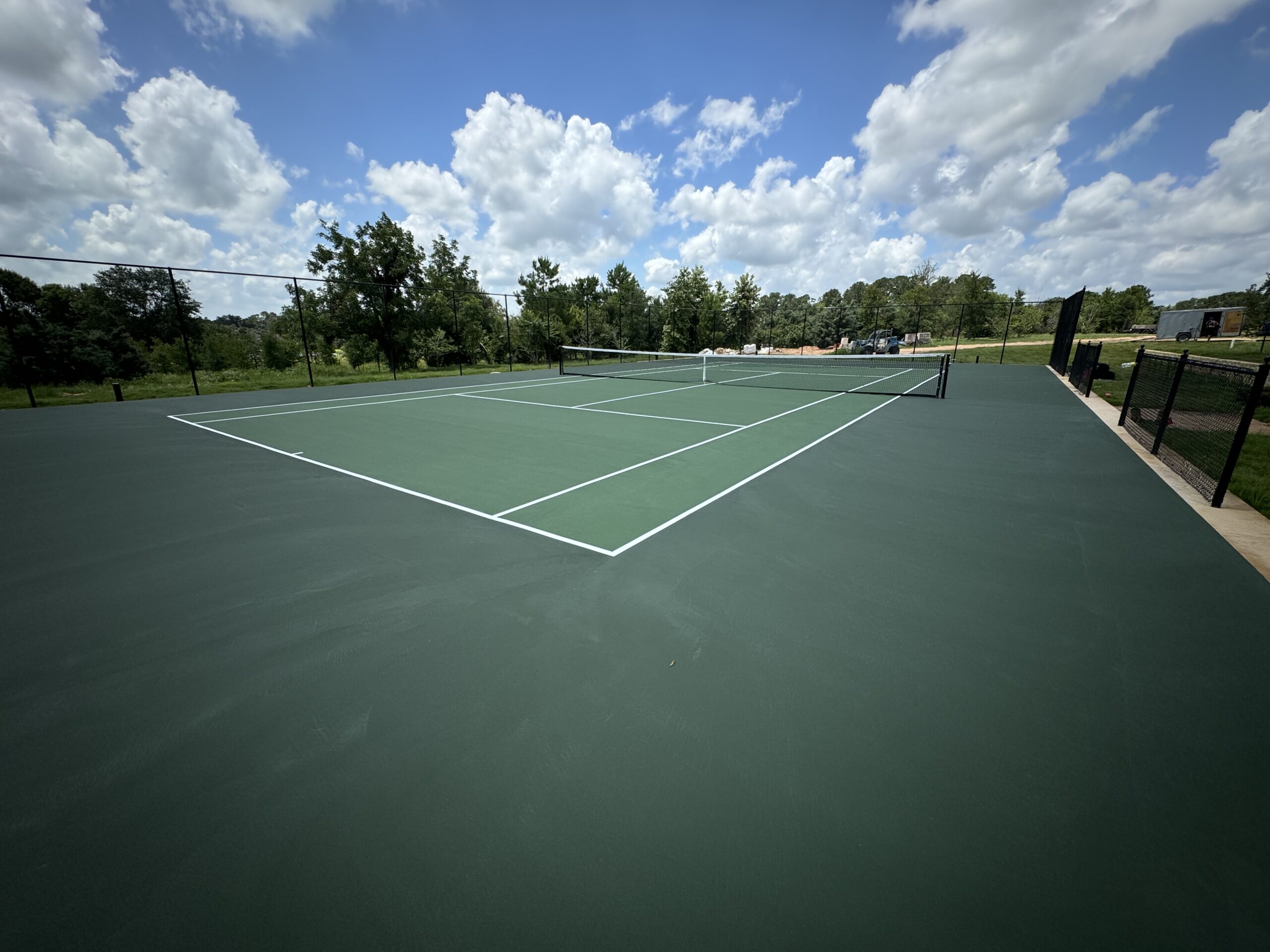
Why Uniformity Matters More Than Maximum Brightness
Imagine standing on a court where the service boxes are extremely bright, but the baselines feel dim.
Your eyes repeatedly adjust as the ball moves between those areas. A shot can disappear briefly against a dark background or become difficult to read when it crosses a harsh pool of light.
Uniformity describes how evenly illumination is distributed across the court.
A system with a high average light level can still perform poorly if its brightest and darkest points are far apart. Players experience the contrast, not the average number printed on the proposal.
A photometric plan models light across a grid and helps show:
• Average illumination
• Minimum illumination
• Maximum illumination
• Uniformity
• Fixture aiming
• Spill beyond the court
• Coverage in important playing areas
The plan should reflect the actual court, pole locations, fixture mounting heights, surrounding property, and selected luminaires.
Generic marketing diagrams are not a substitute for a project-specific calculation.
What Are Foot-Candles and Lux?
Foot-candles and lux are units used to describe illuminance, or the amount of light reaching a surface.
One foot-candle equals approximately 10.76 lux.
The appropriate lighting level depends on how the court will be used. A private residential court for family play does not need the same level as a tournament venue designed for spectators, officials, and television cameras.
For example, certain USTA event specifications call for much higher lighting levels than an ordinary private court. Those requirements should not be copied automatically into a backyard project.
More light also creates more potential glare, spill, energy use, and neighborhood impact. The correct level is the one that supports the intended play while remaining even and controlled.
Use current professional recommendations for the project type. The Illuminating Engineering Society publishes guidance for sports and recreational lighting, including its current recommended practice for these facilities.
How Bright Should a Residential Tennis Court Be?
A residential system should make the ball, lines, net, and surrounding playing area easy to see without turning the property into a stadium.
The appropriate level depends on player age, skill, court color, fixture position, background, surrounding light, and local restrictions.
Older players may appreciate better visibility, but that does not always mean installing brighter unshielded fixtures. Improved uniformity and glare control can be more valuable than increasing output.
A good residential plan should answer practical questions:
• Can players track a high lob from either baseline?
• Are the corners noticeably darker?
• Do fixtures shine directly toward a serving player?
• How much light reaches neighboring property?
• Can the lights be dimmed for casual use?
• Is there an automatic shutoff?
• Are operating hours limited by an HOA or local code?
• Can fixtures be serviced without damaging the court?
Residential lighting should feel like part of the property, not a commercial installation forced into a backyard.
How Does Commercial Tennis Court Lighting Differ?
Commercial facilities generally have longer operating hours, more users, and a wider range of playing needs.
A club may host lessons in the afternoon, league matches after work, competitive events on weekends, and maintenance after closing. Different zones and dimming levels can reduce energy use when maximum output is unnecessary.
Commercial plans may also need to consider:
• Multiple adjacent courts
• Spectator visibility
• Coaching and training
• Emergency lighting
• Security
• Cameras or video analysis
• Scoreboards
• Parking and walkways
• Facility operating hours
• Maintenance access
• Local commercial requirements
Lighting from one court should not create glare on another. Pole positions and fixture aiming need to be coordinated across the entire facility.
The control system should also be simple for staff to operate. A technically advanced system is not helpful if ordinary users cannot turn on the correct courts without confusion.
What Is Glare?
Glare occurs when a bright source interferes with a player’s ability to see comfortably.
In tennis, discomfort glare can come from looking near a fixture during a serve or overhead shot. Disability glare can reduce visual contrast enough to make the ball temporarily difficult to follow.
LED fixtures are sometimes blamed for glare because they can produce intense light from a compact source. The real issue is usually the fixture, optics, aiming, mounting height, and shielding rather than the technology alone.
A well-designed LED system can control glare effectively. A poorly designed one can feel harsh even when it uses less energy than the lights it replaced.
The best way to manage glare is to design around player sightlines from the beginning. Fixtures should not be placed only where installation is easiest.
How Can Light Spill Be Controlled?
Light spill, also called light trespass, occurs when illumination reaches areas where it is not needed.
On a residential property, that might mean a neighbor’s bedroom window, patio, or yard. At a commercial facility, light could affect nearby homes, roads, businesses, or wildlife areas.
The DarkSky outdoor sports lighting guidance recommends optical control, shielding, dimming, and timing controls to reduce spill, glare, and unnecessary night lighting.
Practical methods include:
• Use court-specific optics: Fixtures should direct light onto the playing area instead of sending a broad flood in every direction.
• Add shielding where needed: Shields can limit high-angle glare and prevent light from reaching sensitive neighboring areas.
• Aim and commission the fixtures carefully: Even an appropriate luminaire can create problems when it is aimed from the ground without final verification.
• Use dimming and automatic shutoff: The court should not remain at full output when no one is playing or after the approved operating time.
Property boundaries and neighboring buildings should appear on the lighting plan. Spill cannot be managed properly when the court is considered in isolation.
Does Pole Height Matter?
Yes. Pole height affects aiming angles, uniformity, glare, coverage, structural design, and neighborhood visibility.
Taller poles can sometimes provide smoother distribution and less severe aiming angles. They can also be more visible, require larger foundations, and face stricter local or HOA limits.
Short poles may appear less intrusive but can place bright fixtures closer to a player’s line of sight. They may need more fixtures to cover the court evenly.
There is no single pole height that works for every residential or commercial tennis court.
The correct design depends on:
• Number of courts
• Court orientation
• Property dimensions
• Fixture type
• Required lighting level
• Nearby buildings
• Setbacks
• Wind exposure
• Local height restrictions
• Existing poles in a retrofit
• Maintenance access
Pole foundations should be designed for the equipment and site. Texas wind and soil conditions need to be considered rather than relying on a generic footing detail.
Where Should Tennis Court Light Poles Be Placed?
Pole placement should provide even coverage without interfering with play, fencing, drainage, gates, walkways, or neighboring property.
Fixtures are commonly positioned along the sides of the court, but the number and location depend on the system design.
Poles should remain outside active playing and run-off areas. Their foundations need enough room beyond the court without falling into an easement, drainage path, or inaccessible strip.
The lighting plan should be coordinated with fencing. Installing poles after the fence is complete can create conflicts with posts, windscreens, gates, and maintenance access.
Conduit should also be planned before the foundation and surrounding site work are finished. Cutting through a completed surface to add electrical service is avoidable when lighting is included from the start.
What Color Temperature Is Best?
Color temperature describes whether white light appears warmer or cooler. It is measured in kelvins.
A very warm source can make the court look yellow. An extremely cool source may feel harsh or create stronger neighborhood objections.
The best choice balances visibility, color quality, player comfort, surrounding conditions, and local requirements.
Color rendering also matters. Players should be able to clearly distinguish the ball, lines, surface, net, and surroundings.
A higher color temperature is not automatically brighter, and a lower temperature is not automatically better for neighbors. Output, optics, aiming, shielding, reflectance, and operating hours all contribute to the overall effect.
The lighting designer should present the proposed color characteristics alongside the photometric performance.
Can Tennis Court Lights Be Mounted on Fencing?
Some modern systems use fixtures mounted along or near the fence instead of relying entirely on tall poles.
This approach may reduce visual height and work well for certain residential, retrofit, or space-constrained projects. It can also bring fixtures closer to player sightlines and make shielding especially important.
Fence-mounted systems should be evaluated for:
• Structural capacity of the fence
• Vibration
• Fixture protection
• Electrical routing
• Glare
• Uniformity
• Maintenance access
• Ball impact
• Windscreens
• Local code
• Appearance from neighboring property
A fence designed only to contain tennis balls may not be engineered to support lighting equipment and wind load.
The correct mounting strategy depends on the complete system, not a preference for shorter or taller fixtures.
Do Tennis Court Lights Require a Permit?
They often do.
Light poles can require structural and electrical permits. The project may also be reviewed for pole height, setbacks, fixture specifications, spill light, glare, operating hours, and neighborhood impact.
A residential HOA may have separate rules concerning lighting, recreation structures, and evening use.
Commercial facilities may need engineered plans, electrical service upgrades, accessibility coordination, and compliance with zoning or site plan conditions.
Requirements vary by city and property. Quality & Heritage Court Services works across Austin, Dallas, Houston, San Antonio,
and surrounding Texas communities.
Permits should be investigated before ordering poles and fixtures.
How Much Does Tennis Court Lighting Cost?
Tennis court lighting cost depends on far more than the number of fixtures.
A new residential installation may require poles, engineered foundations, trenching, conduit, electrical service, controls, and permitting. A retrofit may reuse poles and wiring but require structural evaluation or electrical upgrades.
Cost can be influenced by:
• Number of courts
• Residential or commercial use
• Required lighting level
• Fixture quality
• Number and height of poles
• Foundation size
• Soil and wind conditions
• Distance to electrical service
• Trenching and conduit
• Dimming and control systems
• Shielding
• Existing equipment
• Permit and engineering requirements
• Site access
• Commissioning and aiming
The cheapest fixture package may create higher operating, maintenance, or replacement costs later.
A complete proposal should explain what is included, which performance has been modeled, how the system will be controlled, and what responsibility remains with the owner.
Request a quote for an evaluation based on the court and property.
Frequently Asked Questions About Tennis Court Lighting
LED is usually the stronger option for a new installation because it offers instant operation, precise control, dimming, reduced energy use, and less routine lamp replacement. Metal halide can still provide playable light, especially when an existing system is functioning well. Design quality matters more than the technology label alone.
There is no universal fixture count. The answer depends on fixture output, beam patterns, pole positions, mounting height, court count, required lighting level, glare control, and surrounding property. A photometric plan should determine the layout.
Modern LED systems can usually be designed with dimming and separate control levels. A homeowner may use a lower setting for casual play, while a club may use different levels for lessons, competition, maintenance, and unoccupied periods.
LED fixtures are generally designed for much longer operation than traditional lamps, but service life depends on fixture quality, heat management, drivers, environment, surge protection, operating hours, and maintenance. The warranty and expected lumen maintenance should be reviewed, not only a headline hour rating.
They can if the fixtures are too bright, poorly aimed, unshielded, or operated late at night. A well-designed system uses appropriate optics, shielding, dimming, and timing controls to limit spill and glare. The photometric plan should include nearby property boundaries.
Possibly. The poles, foundations, mounting hardware, electrical system, position, and structural capacity should be evaluated. Reusing poles can reduce site work, but it should not preserve an ineffective layout that produces poor coverage or glare.
Why Choose Quality & Heritage Court Services?
Lighting should be planned with the court, not treated as a separate electrical add-on.
Quality & Heritage Court Services considers how the lights interact with the playing area, foundation, fencing, access, drainage, and surrounding property.
New Construction and Existing Courts
Lighting can be included during tennis court construction or evaluated as part of an improvement to an existing facility.
Residential and Commercial Planning
A private family court needs a different system from a multi-court club, school, HOA, resort, or municipal facility.
Texas Site Conditions
Pole foundations, wind exposure, soil, drainage, summer operating hours, and neighboring properties all influence the design.
Complete Court Coordination
The team can coordinate surfacing, fencing, lighting, painting, equipment, and court maintenance services around one practical plan.
Planning a new lighting system or considering an LED upgrade? Contact our team to discuss the court and available options.