
Overview
Professional tennis court fencing installation brings those practical details together. The height, mesh, posts, gates, coating, and placement all need to suit the court and the surrounding property. A private backyard court will not always need the same enclosure as a school, club, or public facility.
Quality & Heritage Court Services installs tennis fencing for new and existing courts. We help property owners choose an enclosure that offers play, withstands outdoor exposure, and fits naturally into the site rather than looking like an afterthought.
Planning a new tennis court or replacing an aging fence? Contact our team to request a site visit to discuss the layout, materials, gates, and installation cost.
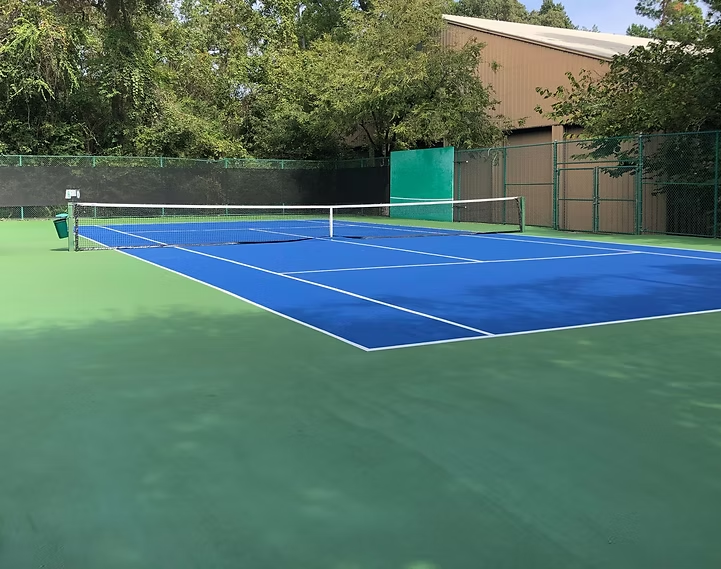
Why Does a Tennis Court Need Proper Fencing?
A fence is not simply a boundary around the playing area. It affects safety, the pace of play, access, visibility, and how the whole facility looks from a distance.
Without enough containment, a routine practice session quickly becomes frustrating. Players spend more time retrieving balls. Balls roll into other activity areas. People walking nearby may have little warning before a ball comes through.
A correctly planned enclosure helps by:
- Keeping more balls within the court so players can continue a rally or practice drill without constant interruptions
- Separating the playing area from roads, parking spaces, pools, gardens, playgrounds, neighboring properties, and pedestrian paths
- Providing a defined access point instead of allowing people to enter from behind an active player
- Reducing the chance of pets or young children wandering onto the surface during play
- Supporting windscreens, privacy screens, dividers, signage, and selected court accessories when the fence has been designed for them
- Giving the property a clean, finished appearance that complements the court, lighting, landscaping, and nearby buildings
The fence also needs to stay out of the players’ way. Posts, rails, gates, and fittings should not create unnecessary projections or sharp edges near the usable playing space.
Choosing the Right Height for Tennis Court Fencing
There is no single fence height that works for every side of every court. Ball movement, available runback, surrounding land use, appearance, local requirements, and budget all influence the layout.
Many full enclosures use taller fencing behind the baselines because deep shots are most likely to leave the playing area there. Side fencing may remain full height, step down in selected areas, or use a lower profile where spectator views matter.
The USTA has identified baseline fences of at least 8 feet and appropriately planned sideline fencing as features considered when reviewing outdoor facilities. Its guidance also highlights wind loads, safe mesh finishing, and accessible gate openings. Those details show why fencing should be planned as part of the facility rather than treated as a generic perimeter barrier.
Full-Height Perimeter Fencing
A tall enclosure around all four sides provides strong ball containment. It can be useful where the court sits close to homes, roads, parking areas, or other amenities.
Full-height fencing is commonly considered for:
- Schools where several groups may use nearby grounds at the same time
- Commercial clubs that want to limit interruptions and keep lessons moving
- Public facilities surrounded by paths, recreation areas, or parking lots
- Residential properties with limited space outside the court boundary
Taller Baselines With Lower Side Sections
Some properties use taller fencing behind the baselines and lower sections along part of the sidelines. This keeps many long balls contained while opening the view for spectators or reducing the sense of enclosure.
A stepped layout must be carefully designed. If the lower section begins too close to the baseline, angled shots may still leave the court frequently. Gate position and windscreen coverage also need to accommodate changes in height.
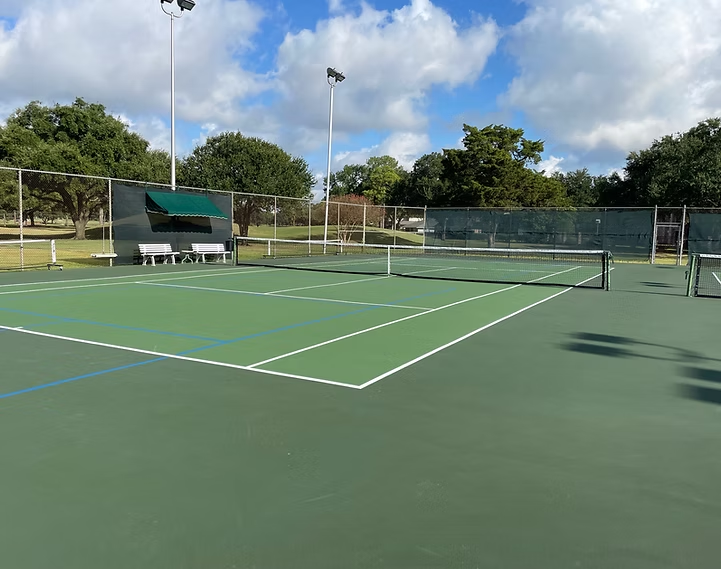
Residential Fence Layouts
A backyard tennis court often needs to balance play with the view from the home, patio, garden, or pool area. That may mean selecting dark vinyl-coated fencing, using lower side sections, or placing gates where they will not dominate the landscape.
The surrounding property still comes first. A court beside a road or neighboring yard may need more containment than one set within a large private estate.
Quality & Heritage Court Services reviews the space on both sides of the court before recommending a height. The useful question is not simply, “How tall should the fence be?” It is, “Where will missed balls go if this section is too low?”
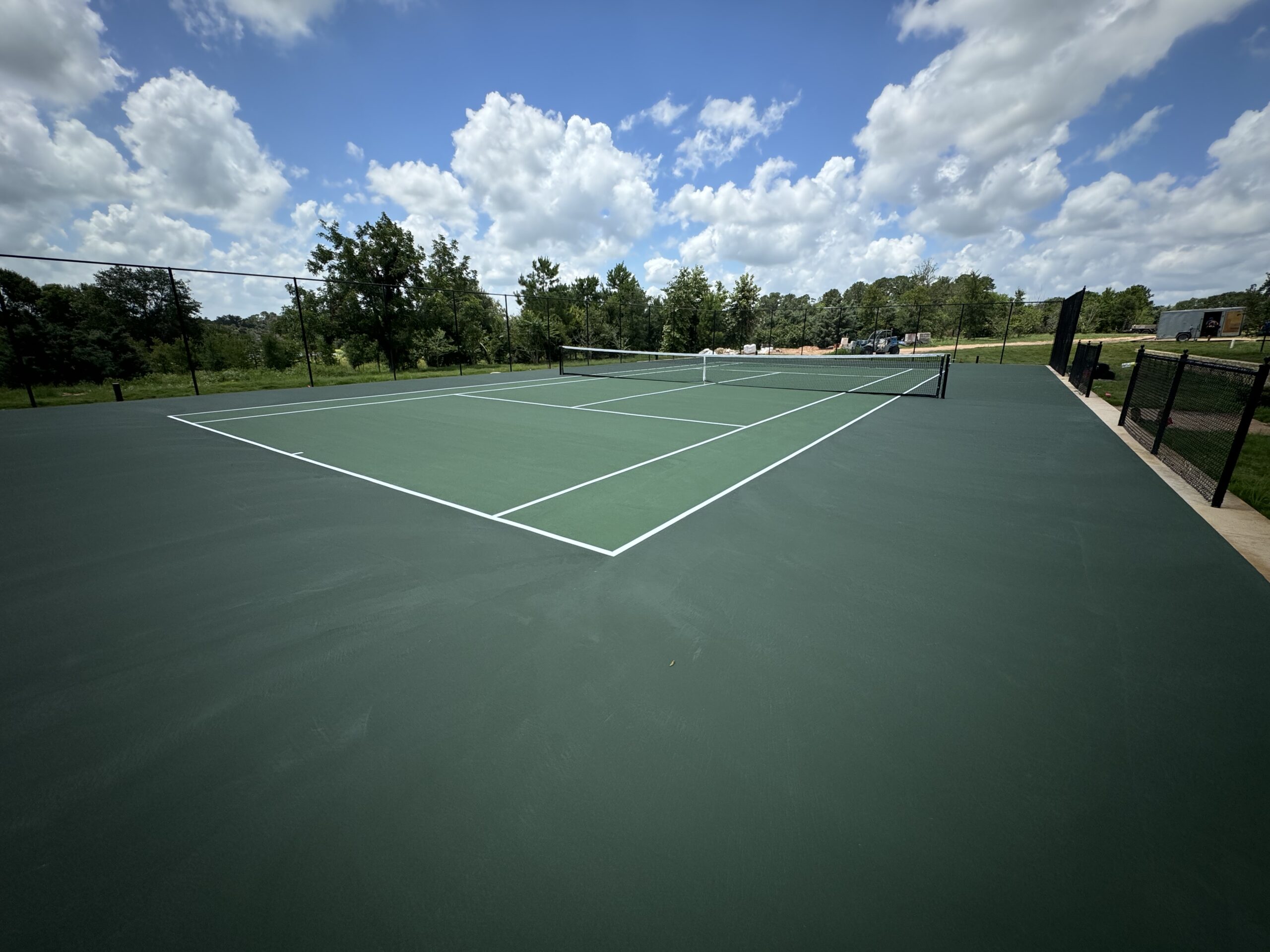
Tennis Court Fence Materials and Finishes
Chain-link fencing remains a common choice because it is durable, practical, and relatively transparent from a distance. Within that category, owners still have decisions to make about coating, mesh, framework, and finish.
Galvanized Chain-Link Fencing
Galvanized steel has a familiar silver finish and offers dependable corrosion resistance. It is frequently used at schools, parks, municipalities, and facilities where function and budget take priority.
The brighter metal is more visible against landscaping and open sky. Some owners like its straightforward appearance. Others prefer a coated system that blends more quietly into the property.
Vinyl-Coated Chain-Link Fencing
Vinyl-coated fencing places a colored protective finish over the wire. Black and dark green are common because they reduce glare and tend to recede visually.
This option works well for:
- Private homes and estates where the court is visible from living or entertaining areas
- Hotels and resorts that want the enclosure to coordinate with landscaping
- Clubs looking for a finished, professional appearance
- HOAs that need the recreation area to fit an established property palette
Mesh Size and Wire Strength
Mesh opening and wire gauge affect rigidity, durability, ball containment, weight, and cost. A suitable system should keep tennis balls inside while standing up to wind, weather, contact, and regular use.
A heavier framework may be appropriate for tall fencing, frequent use, exposed sites, or substantial windscreen coverage. The posts and footings carry the load. Upgrading the fabric without considering the supporting structure does not create a stronger complete system.
Local wind conditions warrant particular attention when planning wind screens. A screen changes how wind passes through the enclosure and can add considerable pressure to posts, rails, fittings, and concrete footings.
Safe Edge Treatments
The cut ends of chain-link fabric should not leave sharp points exposed that could catch clothing or skin. Depending on the fence location and design, the fabric can use knuckled edges or other appropriate finishing details.
This is a minor specification with a clear effect on safety. It matters most around gates, low fence sections, seating areas, and places where children regularly use the facility.
Planning Gates and Court Access
A gate should feel almost uneventful to use. It opens smoothly, closes correctly, provides enough clearance, and does not interfere with play. When a gate is badly placed, everyone notices.
Where Should a Tennis Court Gate Go?
Gates are often positioned along a sideline, away from the active baseline runback. This reduces the chance of someone entering directly behind a player preparing to serve or chase a deep ball.
The best position also depends on the path from home, the clubhouse, the school building, or the parking area. Forcing users to walk around the entire enclosure causes wear on the landscaping and encourages them to look for shortcuts.
On multi-court sites, each court or group of courts may need planned access so players do not repeatedly cross another active area.
Gate Width and Accessibility
The opening must be wide enough for the people and equipment expected to pass through it. Public, school, community, and commercial facilities also need to account for applicable accessibility requirements.
The 2010 ADA Standards for Accessible Design provide federal accessibility requirements, but local codes and project conditions should also be reviewed. Accessible entry involves more than the gate leaf. The route leading to it, threshold, hardware, operating clearance, and surface around the opening may all matter.
A maintenance or equipment gate may be useful if machinery, coating supplies, nets, benches, or other large items will need to enter later.
Latches, Hinges, and Swing Direction
Hardware should be easy for the intended users to operate and durable enough for the facility’s traffic. A residential latch used by a single family has a different workload from a school gate that is opened throughout the day.
Gate leaves should not drag across the playing surface or swing into an unsafe area. Posts need enough support to prevent the gate from sagging over time. Where controlled access is necessary, lockable or self-closing hardware can be discussed during planning.
Windscreens, Privacy, and Visual Comfort
A windscreen can make a court feel more private, reduce visual distractions, and moderate some wind at playing level. It can also give an older fence a cleaner, more unified look.
However, a windscreen should never be attached without checking whether the fence was designed to carry the added load.
What a Windscreen Can Do: Depending on its material, height, and openness, a screen may:
- Soften some wind passing across the playing area, although it will not eliminate changing outdoor conditions
- Reduce visual movement from roads, parking lots, pools, or adjacent activity areas
- Give homes, clubs, and hotels a greater sense of privacy
- Create a uniform background that makes it easier for players to track the ball
- Provide space for approved branding, facility names, or sponsor graphics
Why Wind Load Matters: Open chain-link mesh allows much of the wind to pass through. A covered fence behaves differently. The screen catches more wind and transfers that pressure to the fabric, rails, posts, and concrete foundations.
Tall fences on exposed properties may require closer post spacing, stronger framework, deeper footings, or limited screen coverage. Soil conditions and local building requirements can also influence the design.
If privacy screening is part of the goal, tell the installer before the fence is specified. Adding it later without reviewing the structure can lead to leaning posts, loose fittings, and torn fabric.
Fencing for New Courts and Existing Courts
Fence installation looks different depending on whether the playing surface has already been built.
Planning Fencing for a New Tennis Court
A new project provides the best opportunity to coordinate the enclosure with excavation, drainage, base construction, paving, lighting, landscaping, and access.
Post locations can be established before the final surface is installed. Gates can line up with walkways. Lighting poles can be positioned without conflicting with fence posts. Drainage can move water away without leaving an awkward gap beneath the enclosure.
Planning everything together also protects the court surface from unnecessary cutting or heavy equipment after completion.
Replacing an Existing Tennis Court Fence
Older fencing may have leaning posts, stretched mesh, rusted rails, damaged gates, or concrete footings that no longer hold securely. Some portions may be reusable, but that decision should be made after a physical inspection.
A replacement project needs to consider:
- Whether the existing posts remain straight, stable, and suitable for the new material
- How old concrete footings will be removed without damaging the playing surface
- Whether the previous gate locations still make sense
- If the fence height should change to improve containment or visibility
- Whether future windscreens require a stronger framework
- How the crew will protect the acrylic surface while removing and installing heavy components
Adding Fencing During Court Resurfacing
Fence replacement and resurfacing can sometimes be coordinated, but the order of work matters. Removing posts or footings after a new finish has been applied creates an avoidable risk of chips, stains, and equipment damage.
Changes to the pavement can also affect fence clearance. The USTA notes that adding asphalt during court repair can alter fence and net heights. That is one reason the fence, surface, and equipment should be reviewed together before renovation begins.
Our Tennis Court Fencing Installation Process
A dependable installation begins well before the first post is set.
Walking the Property
We look at the court, surrounding space, access route, elevation changes, nearby structures, landscaping, utilities, and the areas most likely to receive missed balls. On an existing court, we also inspect the condition of the current posts, mesh, gates, rails, and footings.
The site visit gives us a better understanding of how the court is used. A family practice court, a school facility, and a busy commercial club rarely need the same access or containment plan.
Confirming the Layout
Fence height, corner locations, gates, side sections, and equipment access are mapped out before installation. We discuss finish colors, windscreen plans, privacy goals, and whether the fence needs to connect with an existing boundary.
Local setbacks, property lines, utility locations, permits, and applicable building requirements should be confirmed at this stage. Guessing about a boundary or underground service is not worth the risk.
Selecting the Fence System
The mesh, wire gauge, post size, rail system, coating, fittings, and gate hardware are selected based on the approved layout. Wind exposure, fence height, screen coverage, soil, and expected use influence those decisions.
The structure needs to work as a system. Strong mesh attached to undersized posts is still an undersized fence.
Setting Posts and Foundations
Accurate post alignment gives the fence its finished appearance. Holes are placed according to the layout, and the posts are set in suitable concrete foundations.
The crew checks spacing, height, plumb, and alignment before the framework is completed. Gate posts receive particular attention because they carry moving weight and repeated use.
When working alongside an existing acrylic surface, protection and controlled movement of equipment are essential. A good fence should not arrive at the expense of a damaged court.
Installing Rails, Mesh, and Gates
Rails and fittings connect the framework before the fabric is stretched and secured. Proper tension keeps chain-link mesh from sagging, rippling, or moving excessively in the wind.
Gates are hung, aligned, and tested. Hinges, latches, and clearances are checked so users do not have to lift, drag, or force the gate.
Completing the Final Inspection
We walk the full enclosure after installation. Posts, rails, mesh tension, edges, fittings, gates, and surrounding areas are reviewed. Loose material and installation debris are removed.
If windscreens are included, their attachment and clearance are checked during the final review. The owner also receives basic guidance on inspection and upkeep.
Ready to talk through fence height, finish, or gate placement? Contact our team to schedule an inspection and provide an estimate around the property rather than a generic fence package.
What Affects Tennis Court Fencing Cost?
The perimeter length matters, but it is only one part of the price. A shorter fence with tall sections, limited access, heavy framework, and several gates may cost more than a larger, straightforward enclosure.
The estimate may be affected by:
- Fence height: Taller enclosures use more mesh and generally require stronger posts, rails, and foundations.
- Material and finish: Galvanized and vinyl-coated systems have different material costs and visual qualities.
- Wire and framework specifications: Mesh gauge, post diameter, rail strength, fittings, and spacing influence durability and price.
- Number and type of gates: Pedestrian, accessible, maintenance, double-leaf, self-closing, and controlled-access gates require different hardware and labor.
- Windscreen coverage: Screens add material and may require a fence system designed for higher wind pressure.
- Ground and soil conditions: Rock, unstable soil, slopes, drainage features, or buried obstructions can affect post installation.
- Existing fence removal: Cutting, hauling, and disposing of old mesh, posts, rails, and concrete footings adds work to a replacement project.
- Court protection: Working beside a finished surface may require added protection and smaller equipment.
- Site access: Narrow residential entries, walls, trees, buildings, or limited staging space can change how materials reach the court.
- Local requirements: Permits, setbacks, engineering, wind-load criteria, and accessibility provisions may influence the final system.
An estimate should explain the height, materials, gates, finish, removal work, and windscreen assumptions. That detail makes it easier to compare one proposal with another.
Maintenance After Installation
Fencing does not demand daily attention, but an occasional walk around the enclosure can catch problems early.
Look for loose ties, sagging mesh, rusted fittings, bent rails, leaning posts, gate misalignment, and areas where landscaping presses against the fabric. Hinges and latches should continue to move freely.
After high winds or severe weather, inspect windscreens and their attachments. A torn screen can flap hard enough to damage itself and place uneven stress on the fence.
Keep soil, mulch, and standing water away from posts where possible. Vines may look attractive, but their weight and trapped moisture can complicate inspection and shorten the life of some components.
If the court is later resurfaced, paved, or altered, recheck gate clearance and fence height. Changes around the base of the enclosure can affect parts that previously worked correctly.
Why Quality & Heritage Court Services?
Fencing is part of the playing environment, not a separate construction detail that happens to sit nearby.
One Plan for the Court and Its Enclosure
We consider the playing surface, runoff, gates, lighting, access, landscaping, and fence together. That wider view helps prevent posts from colliding with drainage paths or gates from opening into an inconvenient area.
Options That Fit the Property
A tall galvanized enclosure may be right for a school. A dark-coated system with lower viewing sections may suit a private estate or resort. We explain the tradeoffs so the selection is based on use, appearance, and maintenance.
Care Around Existing Surfaces
Replacing fencing beside a finished court requires controlled removal, equipment access, and cleanup. We plan the work to reduce the risk of damaging acrylic coatings, pavement edges, nets, and nearby amenities.
Clear Recommendations
If a post can be retained, a gate should move, or the planned windscreen calls for a stronger structure, we discuss it before installation. The purpose is to build a fence that continues to work after the crew leaves.
Service for Different Property Types
Quality & Heritage Court Services installs and replaces tennis court fencing for homes, schools, colleges, clubs, training centers, HOAs, hotels, municipalities, and commercial recreation properties.