
Overview
A basketball court may look like a slab with a hoop at each end. The quality of the finished court depends on much more than that visible surface.
The soil beneath it, the slope, drainage, concrete or asphalt base, surface coating, line layout, hoop system, lighting, fencing, and space around the court all affect how it plays.
A builder who only focuses on the color and markings may miss the issues that cause cracks, puddles, uneven areas, loose equipment, and early surface wear.
The right basketball court builder should be able to explain the whole project in plain language. They should also be willing to discuss what the site needs before quoting a final price.
Quality & Heritage Court Services designs and builds indoor and outdoor basketball courts for homes, schools, churches, communities, municipalities, and commercial properties across Texas.
Planning a new basketball court? Contact our team to discuss your property, layout, and construction options.What Experience Should a Basketball Court Builder Have?
A good basketball court builder should understand site work as well as the finished playing surface.
The project may involve clearing, grading, soil preparation, drainage, concrete or asphalt, acrylic coatings, lines, basketball systems, fencing, lighting, and future maintenance.
These tasks affect one another. For example, the quality of the coating depends on the condition of the pavement below it. A hoop footing must be planned before the final surface is installed. Drainage needs to be considered before the slab is poured.
Ask whether the builder has completed projects similar to yours.
A backyard half court, a school full court, and a municipal facility will not have the same requirements. They differ in size, traffic, equipment, access, surface expectations, and maintenance needs.
Look for a builder who can show completed work and explain how the project was handled, not someone who only supplies a generic court package.
Will the Builder Inspect the Property Before Quoting?
A site visit should be part of any serious construction discussion.
Aerial images rarely show the full picture. The property may have a slope, soft soil, buried utilities, poor drainage, tree roots, narrow access, or an existing slab that cannot support the proposed finish.
During a site review, the builder should look at:
• Available space and property boundaries
• Elevation changes and likely grading work
• Soil and existing pavement
• Drainage paths and runoff
• Trees, roots, buildings, and utilities
• Equipment access and material delivery
• Setbacks, easements, and HOA restrictions
• Planned use of the court
The position of the court should also make sense for the people who will use it. A court located behind a house may look private, but it could be difficult to reach with construction equipment or uncomfortable to light at night.
Quality & Heritage Court Services provides basketball court construction based on the actual site rather than assuming every property can use the same layout.
Can the Builder Explain the Court Size and Layout?
Basketball court dimensions vary by the level and type of play.
Professional and college courts are commonly 94 feet long by 50 feet wide. High school courts are often 84 feet long by 50 feet wide. A backyard court may be a half court, a shooting area, or a custom size that fits the property.
The builder should ask how the court will be used before recommending dimensions.
A family may want space for casual games and practice. A serious player may want a full layout with regulation markings. A school or community facility may need a size that matches its governing rules.
The FIBA Official Basketball Rules provide international court specifications. Other organizations and school systems may use different layouts.
Full Court or Half Court
A full court offers baskets at both ends and supports a wider range of play. It also needs more land, more pavement, more lighting, and more surrounding clearance.
A half court takes less space and may suit a backyard, neighborhood, or training area. It can still include a three point arc, key, free throw line, and professional hoop system if the available area allows.
Custom Layouts
Not every property needs a regulation court. A custom layout can prioritize shooting, small sided games, youth play, or family use.
The important point is to know what is being changed. A smaller court should not be described as regulation size if it is not.
How Will the Builder Prepare the Ground?
The finished surface is only as stable as the layers underneath it.
The site may need clearing, excavation, grading, soil improvement, compaction, and a properly designed base. On some properties, unsuitable material must be removed before construction can begin.
A builder should explain:
• What will be removed
• How the base will be prepared
• Which material will be used below the surface
• How compaction will be checked
• How the finished slope will move water
• How the edges will be supported
Skipping preparation can lead to settlement, cracking, low areas, and changes in slope. These problems may appear months after the court opens, when the visible coating is blamed for a failure that began below it.
Texas properties can have expansive soil that changes as moisture conditions shift. The base plan should account for the site rather than treating the soil as an afterthought.
Who Is Responsible for Drainage?
Drainage should be assigned clearly in the proposal.
Outdoor courts need enough slope to move rainwater away from the playing area without creating uncomfortable changes in elevation. Water from higher ground, roofs, driveways, and landscaping may also need to be redirected.
Poor drainage can leave puddles, stain the coating, encourage algae, wash out the edges, and weaken the base.
Inside the Court
The playing surface needs a consistent slope and a base that does not trap water. The finished coating should not be expected to correct a grading problem.
Around the Court
The ground outside the slab or pavement should guide runoff away from the court. Drains, channels, collection systems, swales, or retaining features may be needed depending on the property.
At the Discharge Point
Water must have a safe place to go. Sending it toward a neighbor, foundation, walkway, or unprotected slope simply transfers the problem.
A builder who says drainage will be figured out later has not finished planning the project.
What Surface Materials Does the Builder Recommend?
The playing surface affects traction, appearance, maintenance, and long term performance.
Outdoor basketball courts commonly use asphalt or concrete with a compatible acrylic coating system. Indoor courts may use hardwood, synthetic flooring, cushioned systems, or another surface suited to the building and level of play.
The builder should explain why a particular surface fits the project.
Outdoor Acrylic Systems
Acrylic coatings can provide color, texture, and clear lines over a properly prepared base. They need suitable weather, a clean surface, and enough curing time between applications.
Hardwood and Indoor Flooring
Indoor surfaces need to be evaluated as complete systems. The subfloor, moisture conditions, shock absorption, finish, and maintenance all matter.
Cushioned Options
A cushioned system adds resilient layers beneath the finish. It may be worth considering when comfort is important or when the court will receive frequent use.
You can learn more about Cushion X court systems before discussing surface options with a builder.
The lowest price per square foot does not always represent the lowest total cost. Preparation, repairs, installation, maintenance, and expected service life belong in the comparison.
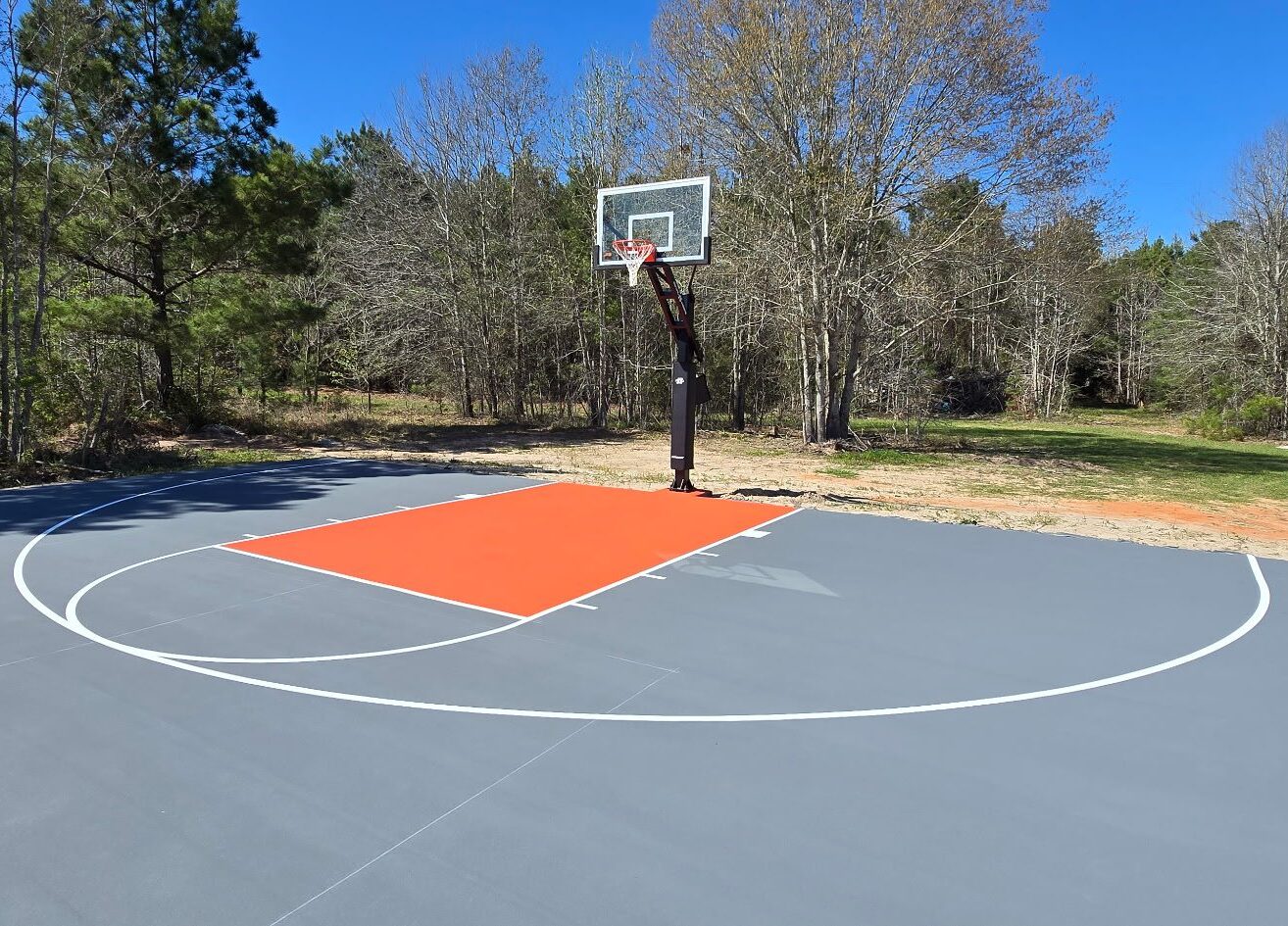
How Will the Builder Handle the Hoops and Equipment?
Basketball equipment should be part of the construction plan from the beginning.
The hoop system may include posts, footings, backboards, rims, padding, nets, anchor hardware, and adjustment mechanisms. Each component has to suit the court and expected use.
A builder should explain the difference between:
• A portable residential goal
• An in ground backyard system
• A school or community goal
• A heavy use professional system
Post footings require accurate placement and adequate depth. The relationship between the post, backboard, rim, free throw line, and playing area should be checked before the surface is finished.
If the court includes more than one basket, the layout needs to be measured from reliable reference points. Guessing at hoop position can leave the markings and equipment out of alignment.
Does the Builder Include Lighting?
Lighting is easier to plan before the court is built.
Pole foundations, electrical routes, controls, and fixture positions can affect the slab, fencing, drainage, and surrounding property. Adding them later may mean cutting into finished pavement or placing poles where they create glare.
A useful lighting plan considers:
• Even coverage across the court
• Glare when players look toward the basket
• Shadows near the backboard
• Pole height and location
• Light spill onto nearby homes
• Electrical service
• Operating hours and controls
• Local or HOA restrictions
Indoor facilities have different concerns. Ceiling height, fixture protection, reflections, and the position of existing lights can all influence play.
Ask whether lighting is included in the construction proposal or priced as a separate addition.
What Should the Builder Include in the Surface and Line Work?
A court should be measured before the lines are painted.
The proposal should state how the base will be prepared, which coatings will be used, how many coats are planned, and when the lines will be applied.
Line work may include the boundaries, center line, free throw lane, free throw circle, three point arc, and custom markings. A backyard court may use fewer lines or a different layout, but the owner should see the plan before painting begins.
Our basketball court painting services include surface preparation, color application, and line marking.
Ask how the builder will handle:
• Cracks and low areas
• Old or incompatible paint
• Color changes
• Multiple line layouts
• Custom logos
• Drying and curing
• Corrections if measurements are wrong
Coating over loose material or painting lines on an unstable base creates problems that fresh color cannot solve.
How Should You Compare Two Basketball Court Builders?
Compare the complete scope, not just the headline price.
One proposal may include excavation, drainage, concrete, coating, hoops, lighting, and cleanup. Another may begin with an existing slab and price only the surface.
Read both documents line by line.
Compare Site Work
Is clearing, grading, soil preparation, compaction, drainage, and disposal included?
Compare the Base
Does the proposal specify concrete or asphalt, thickness, reinforcement, joints, curing, and finish requirements?
Compare the Playing Surface
Look for the coating system, color coats, texture, repairs, line work, and curing schedule.
Compare Equipment
Check the backboard, rim, post, footing, padding, net, anchors, and adjustment features.
Compare the Practical Details
Review access, permits, lighting, fencing, cleanup, warranty terms, maintenance guidance, and exclusions.
A lower total may be reasonable, but only if the same work and materials are included.
What Should Be Included in a Written Proposal?
A written proposal protects both sides by making the work easier to understand.
It should identify:
• The court size and layout
• Site preparation
• Drainage and grading
• Base material and construction
• Surface system and colors
• Line layout
• Hoops and equipment
• Lighting and electrical work
• Fencing and gates
• Permits and engineering
• Cleanup and disposal
• Project schedule
• Payment terms
• Warranty coverage
• Excluded work
The proposal should also describe how changes will be handled if excavation reveals unsuitable soil, old pavement, buried debris, or drainage issues.
Avoid relying on verbal promises for important parts of the project. If a feature matters to the finished court, it should appear in the written scope.
What Warning Signs Should Make You Pause?
Be cautious when a builder gives a final price without asking basic questions about the property.
Other warning signs include vague surface descriptions, no drainage plan, no explanation of the hoop footing, and a proposal that lists only a court kit with no site work.
Pressure to sign quickly can also be a problem. You should have time to review dimensions, materials, exclusions, timing, and responsibilities.
A builder should be comfortable discussing repairs and limitations. No coating can correct unstable soil. No hoop adjustment can fix a failing footing. No line paint can make an undersized court regulation size.
Clear answers are more useful than grand promises.
How Long Does Basketball Court Construction Take?
The schedule depends on the starting condition and the amount of site work.
A prepared base may allow the surface and equipment work to move relatively quickly. A new outdoor court may require clearing, excavation, grading, drainage, base construction, curing, coatings, line painting, and equipment installation.
Weather can affect outdoor work. Rain, high humidity, wind, and extreme heat may delay coating or slow curing.
Indoor projects may avoid rain but still require building preparation, flooring installation, lighting, equipment, and inspections.
Ask what the proposed timeline includes. Design, engineering, permits, material lead times, weather delays, and curing should be discussed before a completion date is promised.
What Maintenance Support Should a Builder Provide?
A builder should explain how to care for the surface and equipment after opening.
Outdoor courts collect leaves, dirt, pollen, dust, and moisture. The coating and lines gradually wear under sunlight and regular play. Hoops, anchors, nets, backboards, fencing, and lights also need inspection.
Routine care may include cleaning the surface, clearing drainage paths, checking equipment, looking for cracks, and watching for changes in traction or ball response.
Quality & Heritage Court Services provides basketball court maintenance
for properties that need cleaning, repairs, resurfacing, equipment checks, and ongoing care.
Ask how often the builder recommends professional inspection and who will handle repairs when a problem appears.
How Does the Decision Change for Commercial and Community Courts?
A court used by many people needs a different plan from a private backyard court.
Schools, churches, communities, municipalities, clubs, and commercial properties may need durable equipment, stronger lighting, accessible routes, storage, seating, fencing, parking, and safe circulation.
The builder should understand what happens when several groups use the space in one day.
Consider:
• How equipment will be stored
• How players enter and leave
• Where spectators will stand or sit
• How maintenance crews reach the court
• Whether lighting can be controlled by zone
• How the surface will handle frequent use
• What accessibility requirements apply
• How future repairs will be completed
A court that looks good on opening day still needs to function during busy weeks, school events, community programs, and scheduled bookings.
What Should Texas Property Owners Consider?
Texas weather and soil can affect every stage of construction.
High heat and strong sunlight can fade coatings and increase surface temperatures. Sudden storms test grading and drainage. Expansive soil may move beneath concrete or asphalt. Trees and irrigation can keep sections of the property wet.
The local setting matters too.
A Houston site may need careful water management. An Austin property may involve slopes, rock, or changing ground conditions. Dallas and San Antonio properties can present their own combinations of soil, weather, access, and drainage concerns.
Quality & Heritage Court Services works with property owners through Houston, Austin, Dallas, and
What Are the Most Common Questions About Basketball Court Builders?
Yes. A site review helps identify slope, soil, drainage, access, trees, utilities, setbacks, and nearby structures. These conditions can change the size, construction method, cost, and schedule.
Someone must be responsible for it, and that responsibility should appear in writing. Drainage affects grading, the base, the pavement, surrounding landscaping, and the long term condition of the surface.
Possibly. The slab needs to be checked for cracks, movement, slope, moisture, flatness, and structural condition. A suitable existing base may reduce the scope, but a coating cannot correct serious pavement failure.
The choice depends on available space, the players, the intended use, and the budget. A half court may suit shooting and casual games, while a full court supports more complete play and requires considerably more land.
It is usually easier to plan lighting with the original project. Pole foundations, wiring, controls, glare, light spill, and local restrictions can affect the court layout and surrounding property.
Compare the complete scope, including site work, drainage, base construction, coatings, lines, hoops, lighting, fencing, permits, cleanup, warranty, and maintenance guidance. A lower total may exclude important parts of the project.
Why Should You Choose Quality & Heritage Court Services?
Choosing a basketball court builder is not only about finding someone who can pour concrete or paint lines.
One Connected Plan
Quality & Heritage Court Services can coordinate site preparation, drainage, base construction, surfacing, line work, hoops, lighting, fencing, and maintenance.
Projects Built Around the Property
A backyard half court, school court, community facility, and commercial project each require a different layout and level of support.
Practical Surface Guidance
The surface is selected around use, comfort, traction, maintenance, budget, and the condition of the base.
Texas Experience
Local weather, soil, drainage, and access are considered before the work is priced and scheduled.
Support Beyond Installation
The relationship can continue with cleaning, repairs, basketball court resurfacing, line repainting, and equipment care.
Ready to discuss a basketball court project? Contact our team for a site evaluation and detailed proposal.