
Overview
Choosing between an outdoor court and an indoor basketball court often comes down to one practical question: how do you expect to use it?
An indoor court gives you a predictable place to play. Rain does not cancel a game, summer heat stays outside, and the floor remains protected from direct sunlight. The tradeoff is cost. Unless you already have a suitable building, you are paying for much more than the court itself.
Outdoor construction is more straightforward. A court can be added to a backyard, school, HOA, hotel, or recreation facility without enclosing an entire building. It is usually less expensive to build, but the surface has to live with Texas sun, storms, dust, and temperature changes.
Quality & Heritage Court Services designs both types of courts. We begin with the space, budget, and intended use, then work out which setting makes sense for the property.
If you are weighing indoor and outdoor options, contact our team for an on-site evaluation before committing to either one.
How Are Indoor and Outdoor Basketball Courts Different?
The main difference is how much control you have over the playing environment.
Indoor Basketball Courts
A building protects an indoor court, so rain, wind, and direct sunlight do not affect the game. Lighting and temperature can also be controlled, making it easier to practice or schedule games throughout the year.
The floor may be maple hardwood or a synthetic athletic material. Building indoors usually costs more because the project can involve roofing, insulation, ventilation, lighting, HVAC, and other building systems in addition to the court itself.
Outdoor Basketball Courts
An outdoor court is open to the weather. Hot sun can warm the surface, wind can affect shots, and rain can keep the court out of use until it dries.
These courts are commonly built on concrete or asphalt and finished with acrylic coatings, cushioning, or modular tiles. They are often easier and less expensive to add to homes, schools, HOAs, hotels, or community properties.
Indoor courts provide dependable playing conditions in every season. Outdoor courts are usually more accessible and easier to fit into an existing property.
Which Court Is More Expensive to Build?
If you are starting with open land, an indoor court will almost always be the more expensive project. You are not just installing a floor and two baskets. You are constructing a building large enough for basketball.
That can mean paying for a foundation, structural framing, roofing, insulation, electrical systems, ventilation, HVAC, fire protection, permits, restrooms, and accessible entrances. Bleachers, wall padding, storage, and scoreboards can push the budget higher.
The calculation changes if you already own a suitable building. A warehouse, private gym, barn, or recreation hall may be converted, provided it has the necessary floor space, ceiling height, structural capacity, and climate control.
Outdoor court costs are concentrated in the ground and playing area. The work may include clearing, grading, drainage, concrete, acrylic surfacing, game lines, goals, fencing, and lights.
A difficult property can still make an outdoor build expensive. Steep grades, poor soil, retaining walls, limited equipment access, and drainage problems all add work. Even then, it rarely carries the same cost as constructing and operating a fully enclosed building.
What Goes Into an Indoor Basketball Court?
The room must be large enough for the desired court layout, but floor area is only the beginning. Players also need clearance beyond the lines, enough height for shots, and safe spacing around walls, columns, doors, and equipment.
The concrete slab beneath the floor should be checked for flatness and moisture. Wood flooring is particularly sensitive to conditions below and around it. A slab that appears dry can still release moisture into the flooring system.
The building environment matters after installation as well. Maple expands and contracts as humidity changes. The Maple Flooring Manufacturers Association recommends maintaining controlled indoor conditions rather than shutting down HVAC for extended periods.
If you are weighing indoor and outdoor options, MFMA flooring guidance.
Lighting should cover the court evenly without shining into a player’s eyes near the basket. The design may also include wall padding, retractable goals, bleachers, divider curtains, scoreboards, and storage.
For a private home, some of these features may be unnecessary. A school or commercial gym may rely on nearly all of them.
What Goes Into an Outdoor Basketball Court?
An outdoor court starts with the land. Before deciding on colors or goals, the builder needs to understand how the property slopes, where water travels, and whether construction equipment can reach the site.
The area is cleared, graded, and compacted before the foundation is installed. Concrete is a common choice for a permanent court because it creates a firm base with consistent ball response.
Rainwater needs somewhere to go. A subtle slope moves it off the court, while surrounding drains or swales may be used to carry runoff away from the slab.
Once the base is ready, the court receives its playing surface and lines. Goals, fencing, gates, seating, and lighting are added around the court without taking away safe player clearance.
Outdoor construction has fewer building systems than an indoor gym, but mistakes below the surface are harder to correct later. Poor drainage or an unstable base will eventually show through the finished court.
How Do Indoor and Outdoor Surfaces Feel During Play?
A well-maintained indoor floor feels controlled. Ball bounce is steady, wind is not a factor, and the surface temperature changes very little during a game.
Maple hardwood has the familiar feel associated with organized basketball. It offers good ball response and allows players to stop and change direction naturally when the finish is properly maintained.
Synthetic indoor flooring can feel slightly different. Some systems provide more cushioning, while others are chosen because they are easier to clean or better suited to multi-use rooms.
Outdoor acrylic produces a dependable hard-court experience. Its texture can be adjusted for traction, and cushioning layers can be added beneath the color coats if players want a more forgiving surface.
Modular tiles are another outdoor option. They can drain quickly and allow individual sections to be replaced, but their ball response and feel vary from one product to another.
Players who train seriously may prefer the consistency of indoors. Families and recreational users may value a court they can step onto whenever the weather is good.
What Happens to an Outdoor Court in Texas Weather?
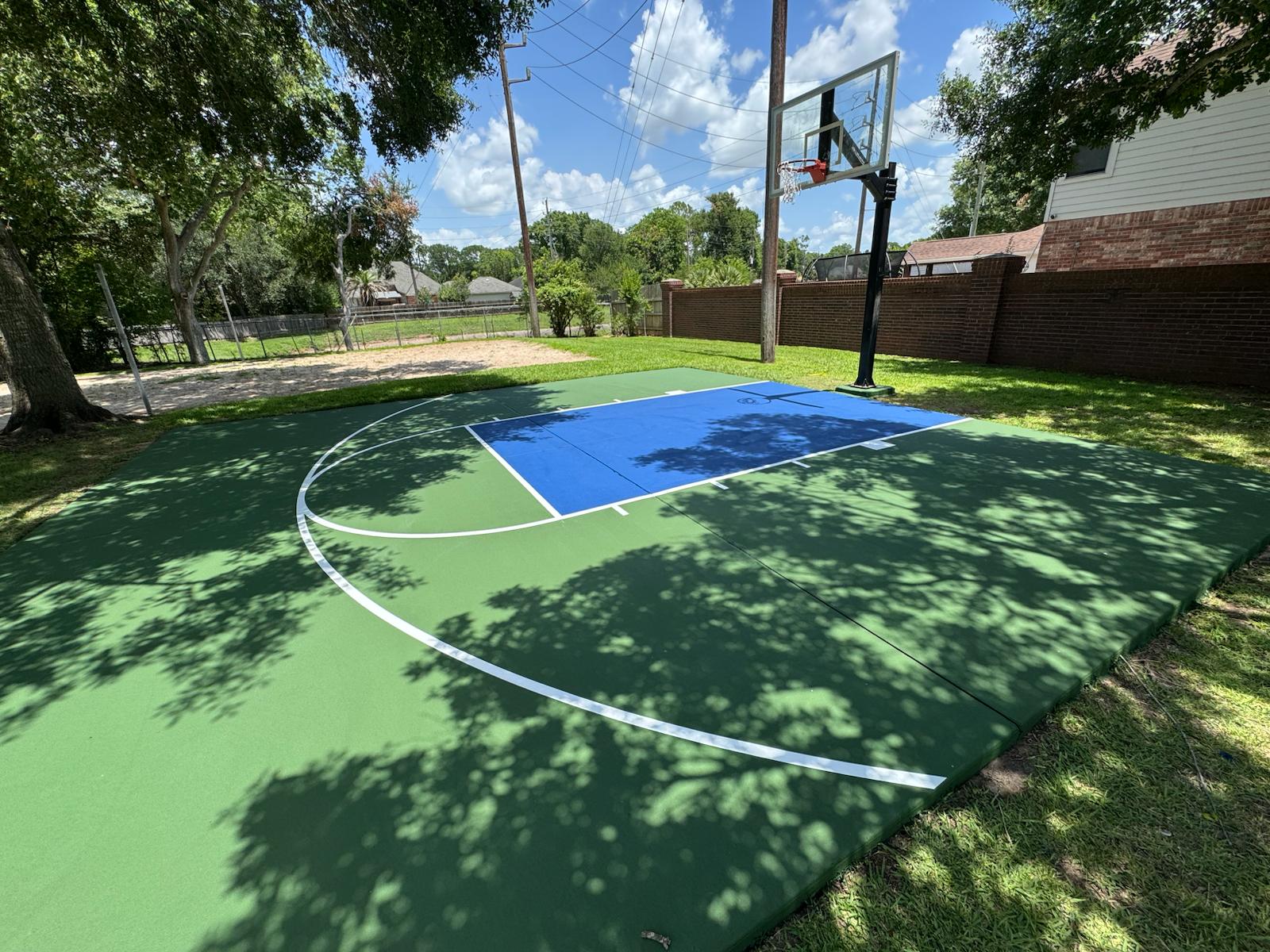
Outdoor basketball courts in Texas spend much of the year under strong sunlight. The surface can become far hotter than the surrounding air, especially when dark colors are used.
UV exposure slowly fades court paint and wears down its texture. Lower-quality coatings may become smooth, brittle, or patchy sooner than products made for outdoor athletic use.
Then there is rain. Texas storms can drop large amounts of water quickly, exposing low areas that were not apparent during dry weather. If puddles return after every storm, the court may have a grading or drainage problem.
The ground beneath the slab also changes. Clay-rich soil swells when wet and shrinks as it dries. A foundation that does not account for this movement may crack, and those cracks can eventually reach the playing surface.
None of this means an outdoor court will fail quickly. It means the foundation, drainage, coating system, and maintenance plan must suit the location.
Which Court Requires More Maintenance?
Outdoor courts need more frequent attention because dirt and weather never take a day off. Leaves, pollen, dust, and organic buildup should be removed before they stain the surface or reduce grip.
After heavy rain, check whether water remains in the same places. Cracks should be examined while they are still small, especially if they reopen after repair. Nets, goals, fencing, and lights also need occasional inspection.
Indoor floors stay cleaner, but they are less forgiving of moisture. Spills should be cleaned immediately, and wet mopping methods that are unsuitable for the floor can cause damage.
Maple flooring also needs professional care. The Maple Flooring Manufacturers Association recommends annual screening and recoating to help maintain friction and protect the finish.
If you are weighing indoor and outdoor options, MFMA screen and recoat guidance.
So which one is easier? For a homeowner, an acrylic outdoor court is usually simpler to look after. For a staffed gym with controlled indoor conditions, a hardwood floor is manageable but requires disciplined care.
Can You Play Year-Round on Both Courts?
An indoor court is available regardless of rain, darkness, extreme heat, or a cold spell. That reliability matters to schools, academies, clubs, and commercial gyms with fixed schedules.
Outdoor courts are more dependent on the weather. Texas allows plenty of playing days, but summer afternoons can be uncomfortable, and storms may leave the surface wet.
Lighting extends outdoor use into the evening, when temperatures are often lower. Shade near the court gives players somewhere to rest, but placing a permanent structure over the playing area requires separate planning.
If guaranteed scheduling matters, indoors has the advantage. If the court is intended for flexible family or community use, weather interruptions may not justify the cost of an enclosed facility.
Does an Indoor Court Need More Space?
A full indoor court needs room for more than the playing lines. Walls, baskets, player runoff, benches, doors, storage, and building systems all require space.
Ceiling height can be just as limiting as floor area. A large room may look suitable until low beams, lights, ducts, or roof supports interfere with high shots.
Outdoor layouts are easier to adapt. You can build a shooting court, half-court, or full court according to the property. A private court does not need to copy professional dimensions unless the owner wants that style of play.
An NBA court measures 94 feet by 50 feet, but many residential projects work well at a smaller scale.
If you are weighing indoor and outdoor options, Jr. NBA court reference.
The useful question is not how large a court can be squeezed into the property. It is how much space can be built while still leaving players enough room to move safely.
Is an Indoor or Outdoor Court Better for a Home?
For most homes, outdoor construction makes better financial and practical sense. A backyard half-court offers plenty of room for shooting, one-on-one games, and family play without requiring a new building.
An indoor court becomes attractive when the property already has a large garage, barn, gym, or similar structure. It may also suit an owner who trains daily and does not want weather to interrupt practice.
Privacy and neighboring properties matter outdoors. Ball noise, bouncing, lighting, fencing, and the location of the baskets should all be considered before choosing the site.
Indoor courts avoid most neighborhood concerns, but the building may still need sound control, ventilation, and an entrance that allows players to come and go without disrupting the rest of the home.
The better residential choice is usually the court that will be used most often, not the one with the longest feature list.
Which Option Works Better for Schools, HOAs, and Commercial Facilities?
Indoor courts help facilities keep a dependable calendar. Practices, leagues, lessons, camps, and rentals can continue even when the weather changes.
That makes indoors attractive for schools, training academies, gyms, and clubs that depend on scheduled programs.
Outdoor courts can add capacity without the cost of another building. An HOA may want a convenient resident amenity. A hotel may prefer an open-air recreation area. A school may use outdoor courts for physical education and informal play while keeping its gym available for organized programs.
A combination can work particularly well. Indoor space accommodates scheduled activities, while outdoor courts handle overflow and casual games.
Commercial planning should begin with expected player numbers, operating hours, supervision, maintenance staff, and the court's contribution to the property.
Can an Outdoor Basketball Court Be Covered Later?
It can, but the possibility should be discussed during the initial design phase.
A future cover needs foundations for its support columns. Those columns must sit outside player clearances, and the roof must direct rainwater away from the slab. Lighting may need to be moved or replaced.
A roof provides shade and protection from rain while leaving the sides open. It does not turn the court into a true indoor facility because temperature, humidity, wind, and dust remain largely uncontrolled.
Adding walls later creates a much larger project involving ventilation, insulation, fire safety, electrical work, and building codes.
If you think a cover may be added one day, planning for it now can prevent the court layout from blocking that option.
Frequently Asked Questions
No. Hardwood is popular for competitive basketball, but synthetic athletic flooring can work well in training areas, schools, private gyms, and multi-use spaces. The final choice should reflect the level of play, maintenance plan, and activities the room will host.
In most cases, yes. An outdoor project does not require an enclosed building, HVAC, insulation, roofing, or interior fire and electrical systems. Difficult site work or premium features can still raise the outdoor budget.
No. Maple hardwood is designed for protected indoor conditions. Rain, humidity, direct sunlight, and temperature changes would damage it. Outdoor courts need surfaces made for continuous weather exposure.
A professional acrylic system over a well-prepared concrete base is a practical choice for many Texas properties. The foundation and drainage are just as important as the coating placed on top.
There is no fixed schedule for every court. Usage, sunlight, drainage, coating quality, cleaning, and repairs all affect timing. Fading, smooth playing areas, peeling, cracks, and recurring puddles are signs that an inspection is due.
Yes. Indoor and outdoor courts can include lines and equipment for volleyball, pickleball, or other activities. The layout should be planned carefully so the markings remain readable and portable equipment can be stored safely.
Why Choose Quality & Heritage Court Services?
Quality & Heritage Court Services builds basketball courts for homes, schools, HOAs, hotels, clubs, and commercial properties.
• Practical Planning: We look at the site or building before recommending an indoor or outdoor system.
• Texas Construction Experience: Soil, drainage, heat, sunlight, and rainfall are considered when we plan an outdoor court.
• Custom Court Design: A private shooting court and a commercial training facility are treated as different projects because that is exactly what they are.
• Complete Court Services: Our work includes construction, surfacing, painting, fencing, lighting, resurfacing, and maintenance.
Not sure which type of court fits your property? Contact Quality & Heritage Court Services today for an on-site consultation and a straightforward comparison of both options.