
Overview
Many Texas property owners begin with the same question: How much does it cost to build a tennis court? In 2026, a complete residential or commercial court will typically cost between $120,000 and $180,000. That estimate usually covers site preparation, drainage, a post-tension concrete foundation, acrylic surfacing, fencing, lighting, tennis equipment, and final site restoration.
Court size is only one part of the calculation. Soil movement, punishing summer heat, sudden downpours, site access, and surface selection can all affect the construction scope. A flat, open property will be easier to build on than a tight backyard with a steep grade or poor drainage.
At Quality & Heritage Court Services, we build residential and commercial tennis courts for properties in Texas. Before recommending a foundation or surface system, our team considers the soil, drainage, available space, access, intended level of play, and the surrounding environment.
Planning a private tennis court or commercial tennis facility? Contact us today to schedule an on-site evaluation and receive a quote for tennis court construction.
How Do Texas Weather and Soil Affect Tennis Court Construction Costs?
In Texas, your environment is the most demanding contractor on the job. If you build a tennis court without accounting for the specific climate and terrain, you’re almost guaranteed to deal with costly repairs within a few short years. Texas weather and soil conditions dictate everything from your foundation design and drainage needs to your final material choices.
Extreme Heat and Unpredictable Weather
Think about what our brutal, relentless summer sun does to anything left outdoors. Standard coatings stand no chance against that kind of UV exposure; they fade, lose their grip, and become brittle. Because concrete and acrylic layers naturally expand in the sweltering heat and contract when a cold front moves in; they are under constant physical stress. If you use subpar materials, that stress leads to jagged, ugly cracks and peeling paint.
The "Texas Clay" Factor
If your property has high clay content, you’re working with soil that acts like a sponge; it swells when it rains and shrinks when it dries. It’s a constant, shifting movement that can destroy a weak foundation in no time. Yes, taking the time to stabilize the soil, engineer a robust drainage system, and pour a high-strength, post-tension concrete slab adds to the initial quote. But think of it as insurance: it’s the only way to stop your court from "walking" or breaking apart as the ground beneath it moves.
Then, there is the surface itself. The acrylic coating you choose has to be engineered specifically for our temperature swings and UV index. Professional-grade products stay flexible and hold their color; generic paints just don’t. Opting for a cheaper, "budget" system might look fine on a spreadsheet today, but it’s a false economy that will cost you double in resurfacing fees down the road.
At Quality & Heritage Court Services, we inspect your soil density, the slope, and the drainage routes before we start. We build a court engineered to thrive in your backyard, regardless of what the Texas weather throws at it.
What Is Included in the Cost of Tennis Court Construction?
A professional tennis court construction bid should be an open book. It shouldn't just be a bottom-line number; it should be a detailed roadmap that accounts for every step of turning a raw piece of land into a high-performance court that’s built to last.
Site Evaluation and Planning
We start by "reading" your property. Before we ever bring in a machine, we’re looking at your elevation, your soil quality, how water naturally behaves on your land, and where the utility lines are buried. We also look at the physical logistics, how our crews and equipment will actually get into your yard. This prep work allows us to design a court that fits your land perfectly, rather than trying to force the land to fit the court.
Excavation and Grading
This is the literal groundwork. We clear, level, and heavily compact the area to create a stable, rock-solid base. Of course, not every site is a blank canvas. If your property has heavy brush, rocky subsoil, a steep slope, or tight access points that require smaller equipment, it will require more labor, but this is the phase where you absolutely cannot cut corners.
Foundation Construction
This is the backbone of your entire investment. We rely heavily on post-tension concrete for our Texas projects. By using a network of high-strength steel tendons to keep the slab under constant compression, we’re effectively making the foundation resistant to the shifting and cracking that usually destroys "standard" concrete slabs.
Drainage Installation
Standing water is the enemy. We engineer a precise, imperceptible slope so that every time it rains, the water sheets off the surface and moves away from your court. Depending on your property, we might need to go a step further and install a system of swales, catch basins, or diversion channels to ensure that runoff from your roof or neighboring slopes doesn't flood your facility.
Surface Application
Once the foundation is cured and ready, we apply the multi-layer acrylic coating. This is the "face" of your court. The final cost here depends on your performance requirements, such as how many coats you want, whether you need a cushioned layer to protect your joints, and the specific color palette or branding you choose to give the court a high-end look.
Fencing and Court Equipment
A finished court generally includes perimeter fencing, gates, net posts, a tennis net, center anchors, and related playing equipment. Fence height, coating, windscreen requirements, and the number of gates can change the cost.
Lighting and Electrical Work
An LED lighting package may include fixtures, poles, concrete footings, underground wiring, trenching, electrical panels, and controls. Electrical access and the desired level of illumination will influence the scope.
Not every contractor packages these items in the same way. When comparing tennis court construction prices, check exactly what is included, what is optional, and which items could change after work begins.
What Types of Tennis Courts Are Best for Texas, and How Do They Affect Pricing?
In Texas, you have several options for court surfaces, but not all of them play nice with our specific climate. While clay and synthetic turf are certainly possibilities, our local heat, drainage demands, and maintenance cycles often make them a more complex and expensive, long-term commitment. For most of our clients, acrylic hard courts are the industry standard for a reason.
Standard Acrylic Hard Courts
Think of this as the "reliable workhorse." When you lay a standard acrylic finish over a post-tension concrete slab, you get a court that offers a consistent bounce, great traction, and serious durability against our shifting soil. For both homeowners and commercial facilities, this is the most budget-friendly and worry-free route.
Cushioned Acrylic Courts
If you play several times a week, your joints will thank you for choosing a cushioned system. We add specialized, resilient layers beneath the color coats to act as a shock absorber. It’s a bit of a higher upfront cost because of the extra materials and specialized labor, but it’s a game-changer for player comfort.
Synthetic Turf Courts
Turf feels fantastic underfoot, but it’s a different beast to build. You need a very sophisticated drainage system to handle a Texas downpour, or you'll end up with a swamp. The price here is driven by the quality of the turf you choose, the infill, and the intensive prep work required to perfect the drainage.
Clay Courts
Clay is a "labor of love." It requires a dedicated irrigation system, daily grooming, frequent watering, and constant replenishment of the material itself. Here in the Texas heat, the maintenance bills and water usage can really start to add up, which is why you see them less often in private backyards.
For the vast majority of our Texas clients, an acrylic surface on a rock-solid post-tensioned concrete foundation hits the "sweet spot" for performance, longevity, and low maintenance.
At Quality & Heritage Court Services, we don't just guess which one is right for you; we walk you through the pros and cons based on your budget, how often you plan to play, and exactly how your property is laid out.
What Are the Dimensions of a Tennis Court, and How Do They Affect Pricing?
A regulation tennis court is 78 feet long. It measures 36 feet wide for doubles and 27 feet wide for singles. These measurements cover only the marked playing area, not the space players need beyond the lines.
The standard tennis court measurements and dimensions are:
• Court Length: 78 feet, with 39 feet between the net and each baseline.
• Court Width: 27 feet for singles and 36 feet for doubles.
• Net Height: 3 feet 6 inches at the posts and 3 feet at the center.
• Recommended Construction Area: Approximately 60 feet by 120 feet, creating an overall footprint of about 7,200 square feet.
That additional space around the playing lines gives players room to serve, run beyond the baseline, and reach wide shots safely. The project may need even more room for fencing, gates, lighting poles, drainage, walkways, shade, seating, landscaping, and maintenance access.
These dimensions affect the price because they determine how much land must be cleared and how much concrete, acrylic surfacing, fencing, and drainage work the project will use. Setbacks, utility easements, elevation changes, and access for construction equipment must also be considered before the court location is finalized.
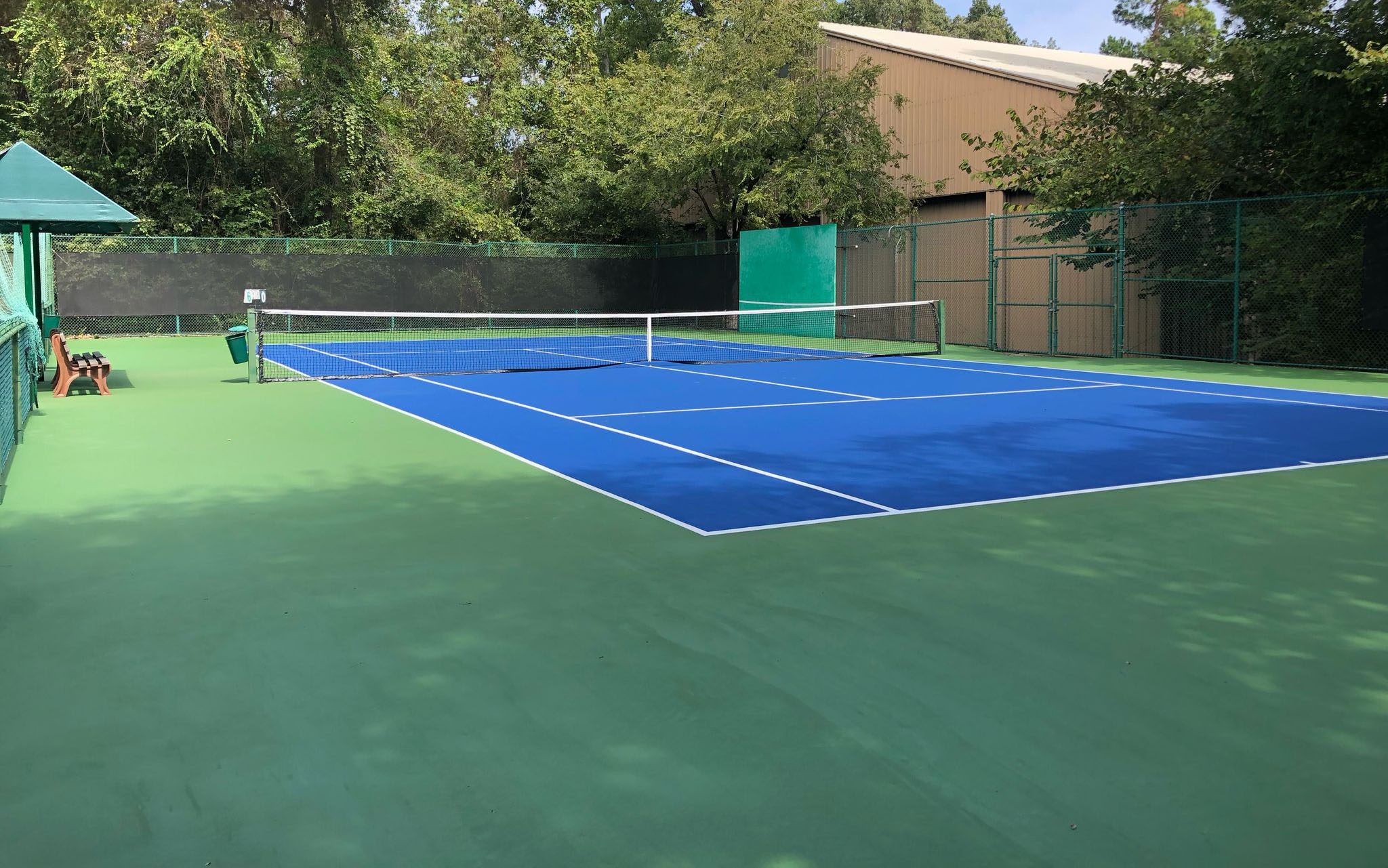
How Do Residential and Commercial Tennis Court Costs Compare?
A straightforward residential court will often cost less than a commercial installation. That changes, however, when a private owner chooses premium materials or extensive customization. A luxury backyard court can cost as much as some commercial projects.
Residential Tennis Courts: Cushioned surfacing, decorative fencing, low-spill lighting, custom colors, shade structures, rebound walls, landscaping, and additional game lines can raise the price. The design may also need to protect privacy and limit the effect of lighting on nearby homes.
Commercial Tennis Courts: Schools, clubs, HOAs, hotels, and municipal facilities may need heavier-duty surfaces, accessible pathways, divider netting, spectator areas, equipment storage, stronger lighting, and enhanced drainage.
Multi-Court Construction: Building several courts together may allow some mobilization and infrastructure expenses to be shared. Even so, a larger site and more complex facility requirements will increase the total investment.
A useful estimate should reflect how often the court will be played, who will use it, the level of maintenance available, accessibility needs, and the long-term purpose of the facility.
How Does the Foundation Affect the Cost to Build a Tennis Court?
The foundation is one of the largest expenses in tennis court construction, and it is not an area where choosing the lowest price always pays off.
Post-tension concrete contains steel tendons that place the slab under compression. This creates a more unified foundation that is better able to resist movement caused by changing soil moisture and temperature.
Asphalt can cost less initially, but it may be more susceptible to oxidation, softening, movement, and cracking. Whether that tradeoff makes sense depends on the site and how long the owner expects the court to remain in service.
Soil conditions, drainage, expected use, and future maintenance should all shape the foundation decision. If the base is not suited to the property, cracks and uneven areas can appear through the finished playing surface, leading to repairs that could have been avoided.
How Does Drainage Affect Tennis Court Construction?
Effective drainage is essentially the only thing standing between your court and premature deterioration. If you don't manage water properly, it will inevitably find its way into the foundation, leading to staining, structural shifting, and expensive surface failure down the line.
We ensure every court is engineered with a precise, imperceptible slope that sheds water away from the play area as efficiently as possible. But the court itself is only half the battle; we also have to look at the "off-court" environment. We evaluate how water moves across your land, ensuring that runoff from your roof, driveway, or neighboring hills is diverted around your facility rather than through it.
Depending on your site’s topography, this might involve basic grading or require the installation of specialized swales, catch basins, or diversion channels. While this drainage work adds a line item to your initial construction quote, it is a critical investment. Correcting a drainage problem after the court is finished is always far more disruptive and costly than getting it right from the start.
This is especially vital in Texas, where we deal with violent, short-burst downpours followed by baking heat. Even if the court looks perfectly dry on top, improper water management beneath the slab can lead to catastrophic foundation issues that won't show up until it's too late. At the end of the day, a court that stays dry underneath lasts for decades.
How Long Does It Take to Build a Tennis Court in Texas?
You should generally expect your project to take between eight and twelve weeks from the moment we break ground. Of course, every site is different; factors like local permitting, weather patterns, the specific curing requirements for the concrete, and the surfacing materials you choose can all shift the calendar.
Here is the breakdown of how we get from raw dirt to a finished, tournament-ready court:
Site Evaluation and Preparation
We start by walking the land to assess soil stability, drainage routes, and equipment access to the site. Once we have a plan, we clear, level, and heavily compact the area. If your site has significant elevation changes or tough soil, this stage will naturally require a bit more time to ensure the base is rock-solid.
Drainage and Foundation Construction
Before the slab is poured, we install the entire drainage system. Once that’s set, we pour the post-tension concrete. We must let the concrete cure properly; if we rush this step, the foundation won't have the structural integrity it needs to withstand the Texas heat and soil movement.
Fencing and Lighting Installation
Once the slab is ready, we move on to the "vertical" work. We set the fence posts, install the gates, and mount the light poles. We also handle all the trenching and wiring during this phase. If our crews have clear access to the court perimeter, this usually moves along quite efficiently.
Surface Coating and Court Lines
This is the "artistic" phase. We prep the foundation and begin applying the multi-layer acrylic system. This is where we have to be most mindful of the weather; each coat needs the right temperature and low humidity to bond and dry properly.
Equipment and Final Inspection
We finish by installing the net system and any extras you’ve selected. After a final, thorough cleaning and inspection, the court is ready for its first match.
We’re realistic about Texas construction. Unexpected heavy rain, extreme humidity, or administrative delays in the permitting office can sometimes throw a wrench in the schedule. That said, we refuse to rush the curing or coating processes to make up for lost time. A tennis court is a long-term investment, and taking a few extra days to do it right is the only way to ensure the surface holds up for decades to come.
What Does Tennis Court Maintenance Include?
Maintaining a tennis court here in Texas doesn't have to be a headache. You don't need a PhD in athletics, but you do need to stay consistent. The name of the game is prevention: stop the dirt, the weather, and the minor imperfections from snowballing into a major, expensive repair bill.
Surface Cleaning
Treat your court like a high-end deck. You need to keep leaves, pollen, dust, and organic debris swept off the surface. If you let that stuff sit, it doesn't just look messy; it traps moisture against your acrylic finish, which can lead to staining and premature wear.
Crack and Surface Inspection
Walk your court regularly and look for the "little" things: hairline cracks, fading patches, or low spots that hold water. If you catch these early, you can seal them before water has a chance to burrow down into your foundation and cause real damage.
Drainage Maintenance
Think of this as your court’s immune system. Keep your drains and the surrounding runoff areas completely clear, especially as we head into storm season. If water is allowed to sit on the court rather than shedding away, it will eventually break down your coating and make any existing defects worse.
Equipment and Perimeter Care
Give your gear the once-over. Check your net posts, fencing, gates, and light fixtures every few months to make sure nothing is rusting, shifting, or rattling loose. A loose fence bracket or a corroding net post is much cheaper to fix now than to replace entirely later.
Periodic Resurfacing
Even the best acrylic courts eventually need a refresh. You’re typically looking at a full resurface every four to eight years. Of course, that timeline depends on how much abuse the court takes; heavy club play or neglected repairs will naturally shorten the window, while a well-kept private court can go the distance.
If you are managing a club, school, or commercial facility, regular professional inspections are a must. High traffic means minor issues grow exponentially faster.
Frequently Asked Questions
You should generally budget between $4,000 and $10,000 for a fresh coat of paint. The final number really depends on the court’s current state, the type of coating system you choose, the number of layers, and whether you're adding custom graphics or complex line work. If your court already has cracks, birdbaths (low spots), or peeling paint, we’ll need to handle those repairs first. We always recommend an inspection to see if you can get away with just a new color coat or if you’d be better off with a full resurfacing.
Absolutely. If your court is strictly for daytime use, you don’t need lighting at all. That said, if there is even a slim chance you’ll want to play at night down the road, I highly recommend running the electrical conduits during the original construction. It is a minor expense now, but it saves you from having to tear up your landscaping and concrete later.
Don't assume it does. Every contractor quotes this differently; some bundle it into a "turnkey" price, while others list it as a separate line item. Check your proposal carefully; it should clearly detail the fence height, the specific materials and coatings, the gate configuration, and whether windscreens are included in the package.
Yes, pickleball lines on a tennis court are a popular way to get more use out of your space. We can overlay pickleball lines to turn your tennis court into a multi-use facility. We just need to nail down the layout, net system, and color scheme during the design phase so the lines don't become a visual distraction during a tennis match.
Typically, you are looking at every four to eight years. It really comes down to the "life" the court leads; a private court at home will last longer than one at a busy school or club. UV exposure, how well you handle drainage, and whether you stay on top of minor repairs will ultimately dictate how long that acrylic finish stays in top shape.
Standard acrylic hard courts are the industry favorite for a reason. They are the definition of "low-effort" in the Texas climate. You still need to keep them clean, check your drains, and handle the occasional crack, but you won't be shackled to the daily watering and grooming rituals that clay or grass courts demand.
Why Choose Quality & Heritage Court Services?
Quality & Heritage Court Services designs and builds residential and commercial tennis courts around the realities of each Texas property. We review the soil, drainage, access, available space, intended use, and maintenance expectations before developing the project.
• 35 Years of Industry Experience: Our background across construction, fitness, and athletics helps us balance structural quality with the way players will actually use the court.
• Built for Texas Conditions: The foundation, drainage, surface, and surrounding features are selected with local soil and weather exposure in mind.
• Custom Residential and Commercial Solutions: We work with homeowners, schools, clubs, HOAs, hotels, and commercial facilities, rather than forcing every project into a single standard design.
• Complete Court Services: Our capabilities include construction, surfacing, painting, fencing, lighting, resurfacing, and ongoing maintenance.
Planning a private tennis court, school facility, HOA amenity, hotel court, or commercial tennis complex? Contact Quality & Heritage Court Services to schedule an on-site consultation and receive a detailed construction estimate.